
![[Notice] Temporary Maintenance Oct 8 PDT / Oct 9 CEST](https://clan.akamai.steamstatic.com/images/46074831/acaf8855d3caa78719852fa866d8fae0245e46e7.png?#)















Returning to Enslaved: Odyssey to the West, the Uncharted rival that put Ninja Theory on the map
No, it's nothing like the book. Enslaved may be based on a piece of classic Chinese literature (Wu Cheng'en's Journey To The West) but it takes substantial liberties with the source material. Rather, the original text serves as a starting point for a very different kind of adventure – one that, all these years later, might sound familiar. Stop us if you've played this one before: a taciturn, world-weary man reluctantly escorts a smart but naïve young woman across a ruined America. Pockets of human survivors eke out a miserable existence in this overgrown world, no longer the planet's dominant species. The pair's westward journey brings moments of tragedy and hope, as an uneasy alliance steadily blossoms into something more meaningful, before an ending that hangs upon a choice between living a blissful lie or confronting a horrifying truth. To return to Enslaved after playing The Last Of Us is to be shocked at how many similarities there are between the two. Both feature strangely beautiful future dystopias; both deliberately subvert the traditional pioneer's journey across America; both feature odd-couple central relationships that endeavour to sidestep cliché (and mostly succeed). More pertinently, both display a rare commitment to ludonarrative consistency. Here are worlds that have been meticulously thought through, where every part is congruous to an internal logic. (Image credit: Ninja Theory) Almost immediately, you can see the benefit of having your writer and lead actor involved from the start. After a whirlwind opening set-piece, scribe Alex Garland (The Beach, 28 Days Later, Ex Machina) establishes the setup with admirable economy: tech-savvy Trip frees herself from a slave ship, leaving via its final escape pod, before placing an electronic headband on fellow survivor and playable protagonist Monkey while he recovers from the crash. This device, as he learns in painful fashion, forces him to do as she says. Your mission is detailed in a single line: "Get me back to my home, and you can go back to yours." There's a plausible narrative excuse for ensuring your partner's safety, too: we learn that the headband is tracking Trip's own biometrics, and will deliver a lethal jolt to Monkey should her heart stop beating. "If I die, you die," she says, simply. So in a single cutscene, we have our motivations for both joining Trip and keeping her alive. It's abundantly clear that Garland not only plays games but understands that players have limited patience for this sort of thing. Few story-led games cut to the chase this quickly, but then few story-led games involve the writer from the beginning. Enslaved offers evidence for the case that it's better to knock the story into shape while building the game than it is once most of the work has already been done. Monkey Magic Enslaved maintains this snappy pacing throughout its opening hours. Trip's skills as a hacker provide a credible reason for a HUD that allows the player to see Monkey's health bar and his shield, as well as Trip's vital signs. Soon afterward, you're tasked with catching a dragonfly mech that Trip then presses into service as a remote camera, swooping over environments to scan them in advance for hazards and enemies. Thus the game excuses the visual overlays that highlight the detection radii of dormant mechs in the area, as well as the sensor triggers for mines, and waypoints that mark your immediate destination. Indeed, the sequence leading to its capture serves both useful narrative and mechanical purposes. It's an engaging bit of simple parkour that develops the central relationship, starting to defuse the hostility caused by Trip's coercion and to build a rapport between the leads, while also injecting some necessary levity. Nitin Sawhney's versatile soundtrack, meanwhile, adopts a whimsical, light-hearted tone as Monkey grows frustrated by the elusive bug. (Image credit: Ninja Theory) Elsewhere, the first mech encounter highlights both Trip's vulnerability and Monkey's awareness of the dangerous world outside the gated enclaves of the remaining human population. Trip can set off an EMP to temporarily disable the robots that attack her, or create an electronic decoy as a temporary distraction, but Monkey's the only one strong enough to dismantle them. This leads to a neat reversal of the masterslave relationship: in Monkey's domain, it's as important that Trip listen to him as he to her, so explaining a radial command menu that lets Monkey tell Trip when to move and when to stay put. In a game assembled so intelligently, it's a pity developer Ninja Theory doesn't always credit its players with similar smarts. When Trip squeals and struggles to cling on after Monkey's thrown over a gap, it's obvious we need to quickly leap across and pull her up, though a text prompt pops up to spell it out. It's the game's most vexing trait. Still, Garland's influence is immediately apparent – as, too, is that of Andy Serkis. Whatever it is t
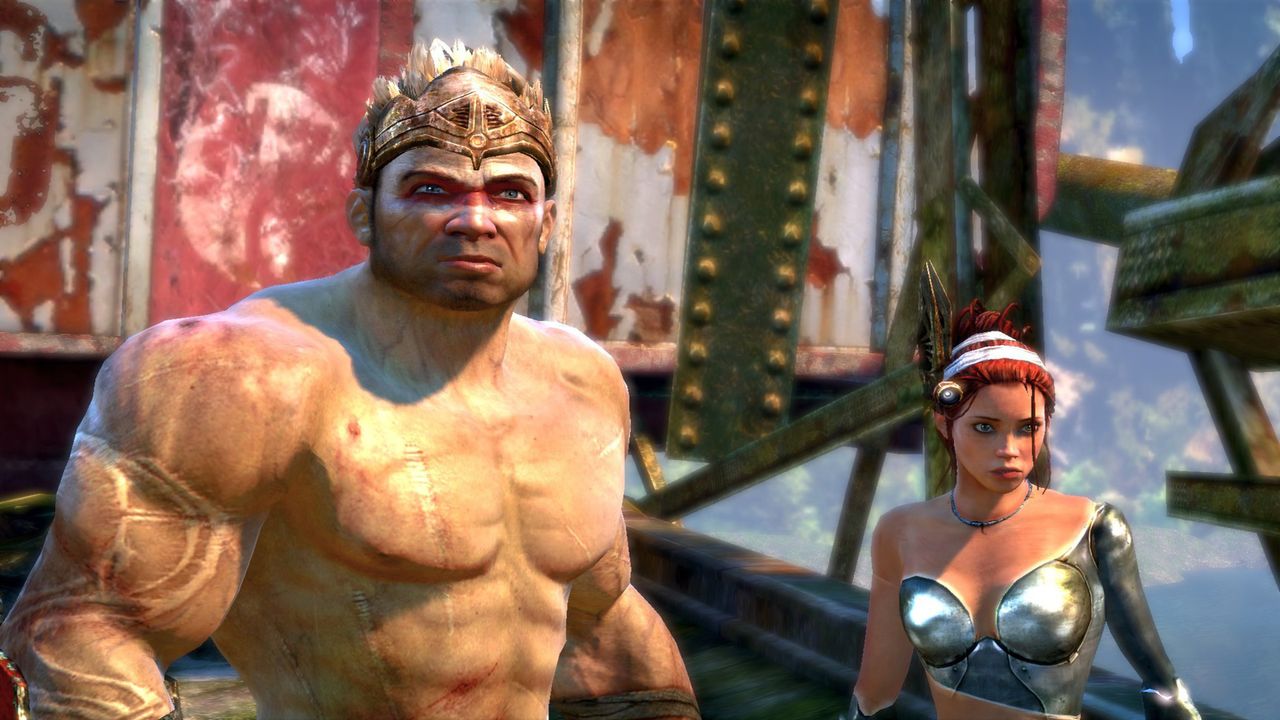 No, it's nothing like the book. Enslaved may be based on a piece of classic Chinese literature (Wu Cheng'en's Journey To The West) but it takes substantial liberties with the source material. Rather, the original text serves as a starting point for a very different kind of adventure – one that, all these years later, might sound familiar. Stop us if you've played this one before: a taciturn, world-weary man reluctantly escorts a smart but naïve young woman across a ruined America. Pockets of human survivors eke out a miserable existence in this overgrown world, no longer the planet's dominant species. The pair's westward journey brings moments of tragedy and hope, as an uneasy alliance steadily blossoms into something more meaningful, before an ending that hangs upon a choice between living a blissful lie or confronting a horrifying truth.
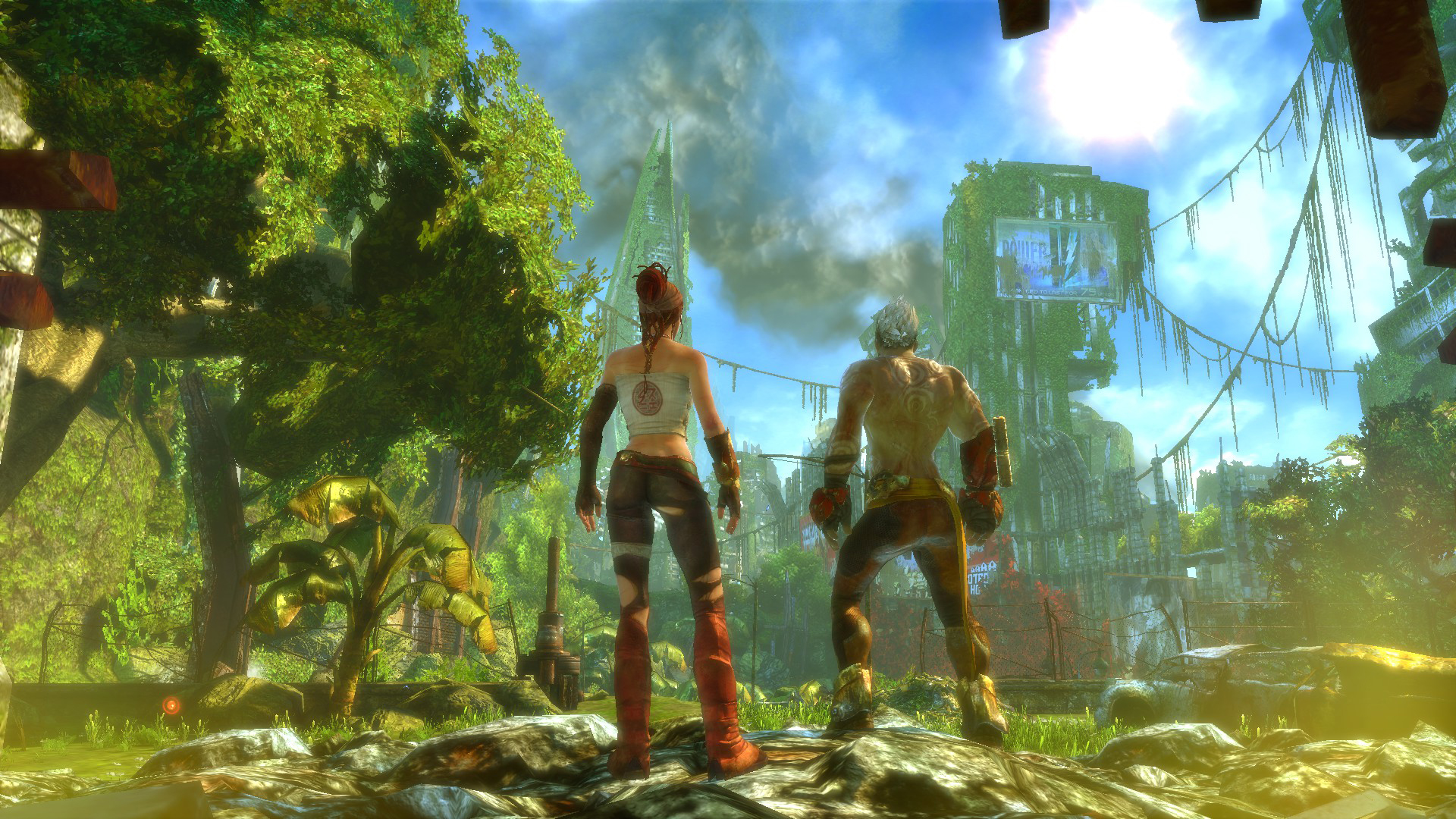
 To return to Enslaved after playing The Last Of Us is to be shocked at how many similarities there are between the two. Both feature strangely beautiful future dystopias; both deliberately subvert the traditional pioneer's journey across America; both feature odd-couple central relationships that endeavour to sidestep cliché (and mostly succeed). More pertinently, both display a rare commitment to ludonarrative consistency. Here are worlds that have been meticulously thought through, where every part is congruous to an internal logic.
(Image credit: Ninja Theory) Almost immediately, you can see the benefit of having your writer and lead actor involved from the start. After a whirlwind opening set-piece, scribe Alex Garland (The Beach, 28 Days Later, Ex Machina) establishes the setup with admirable economy: tech-savvy Trip frees herself from a slave ship, leaving via its final escape pod, before placing an electronic headband on fellow survivor and playable protagonist Monkey while he recovers from the crash. This device, as he learns in painful fashion, forces him to do as she says. Your mission is detailed in a single line: "Get me back to my home, and you can go back to yours."
There's a plausible narrative excuse for ensuring your partner's safety, too: we learn that the headband is tracking Trip's own biometrics, and will deliver a lethal jolt to Monkey should her heart stop beating. "If I die, you die," she says, simply. So in a single cutscene, we have our motivations for both joining Trip and keeping her alive. It's abundantly clear that Garland not only plays games but understands that players have limited patience for this sort of thing. Few story-led games cut to the chase this quickly, but then few story-led games involve the writer from the beginning. Enslaved offers evidence for the case that it's better to knock the story into shape while building the game than it is once most of the work has already been done.
Monkey Magic
Enslaved maintains this snappy pacing throughout its opening hours. Trip's skills as a hacker provide a credible reason for a HUD that allows the player to see Monkey's health bar and his shield, as well as Trip's vital signs. Soon afterward, you're tasked with catching a dragonfly mech that Trip then presses into service as a remote camera, swooping over environments to scan them in advance for hazards and enemies. Thus the game excuses the visual overlays that highlight the detection radii of dormant mechs in the area, as well as the sensor triggers for mines, and waypoints that mark your immediate destination. Indeed, the sequence leading to its capture serves both useful narrative and mechanical purposes. It's an engaging bit of simple parkour that develops the central relationship, starting to defuse the hostility caused by Trip's coercion and to build a rapport between the leads, while also injecting some necessary levity. Nitin Sawhney's versatile soundtrack, meanwhile, adopts a whimsical, light-hearted tone as Monkey grows frustrated by the elusive bug.
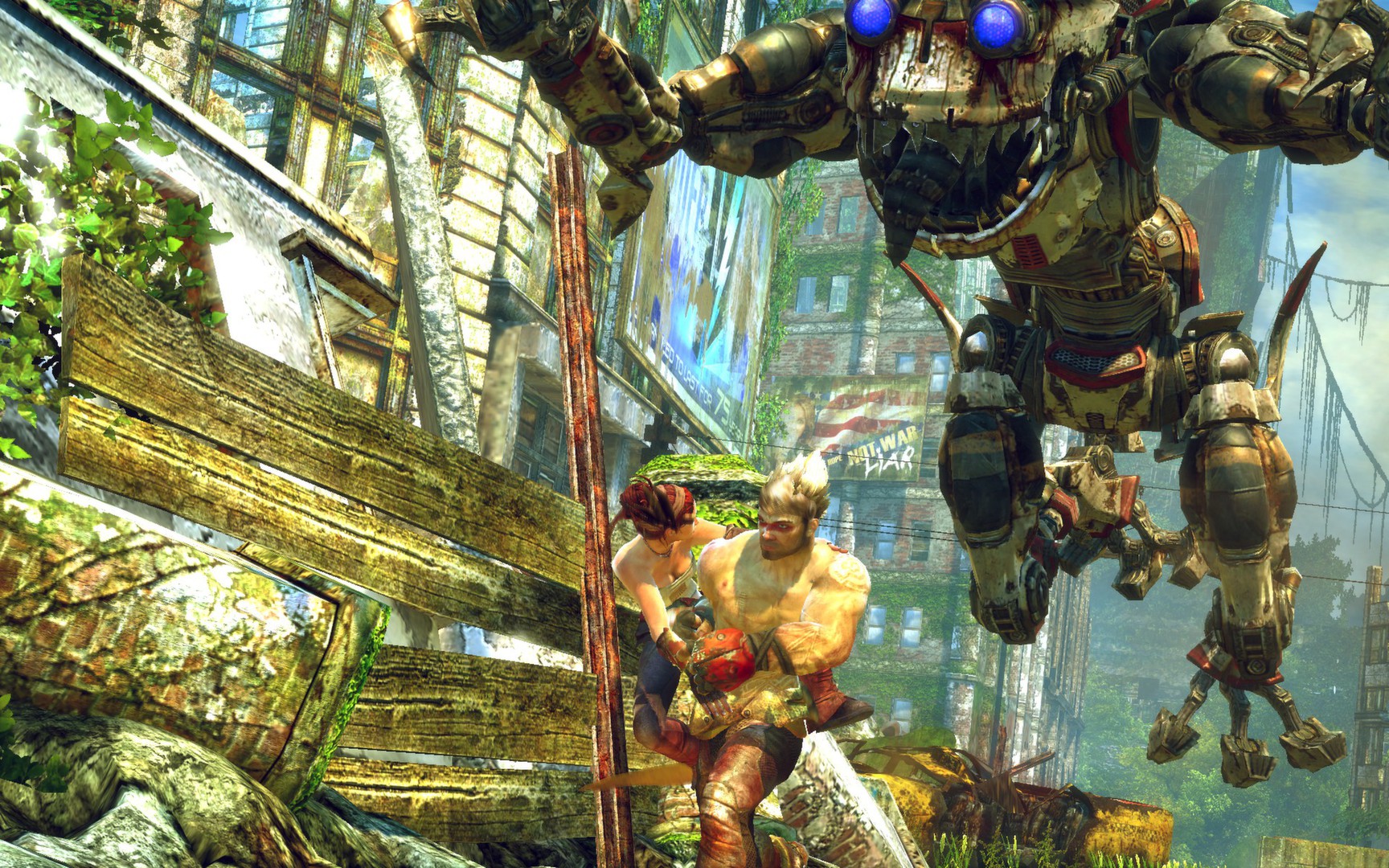
(Image credit: Ninja Theory) Elsewhere, the first mech encounter highlights both Trip's vulnerability and Monkey's awareness of the dangerous world outside the gated enclaves of the remaining human population. Trip can set off an EMP to temporarily disable the robots that attack her, or create an electronic decoy as a temporary distraction, but Monkey's the only one strong enough to dismantle them. This leads to a neat reversal of the masterslave relationship: in Monkey's domain, it's as important that Trip listen to him as he to her, so explaining a radial command menu that lets Monkey tell Trip when to move and when to stay put. In a game assembled so intelligently, it's a pity developer Ninja Theory doesn't always credit its players with similar smarts. When Trip squeals and struggles to cling on after Monkey's thrown over a gap, it's obvious we need to quickly leap across and pull her up, though a text prompt pops up to spell it out. It's the game's most vexing trait.
Still, Garland's influence is immediately apparent – as, too, is that of Andy Serkis. Whatever it is that allows Serkis to tap so expertly into a simian mindset, it's powerfully evident here. Broad-shouldered and hunched, cloth 'tail' dangling from his belt, Monkey is clearly strong enough to beat seven shades of steel from mechanoid opponents, yet he's also athletic enough to swing easily between poles and vines. And that's before you see him move. He scampers up handholds with disarming speed, and has possibly the most satisfying ladder-climbing animation of its era, nimbly skipping several rungs to reach the top in an instant.
Garland's dialogue is more than up to metaphorical heavy lifting, and Monkey does the physical equivalent
Many saw the game's sticky platforming as a flaw, but it's consistent with the character. Monkey's no Nathan Drake, no boulderer scrabbling desperately across conveniently crumbling rock faces. Sure, he suffers a small handful of scripted falls, but not one is his fault: under your command he's a capable – nay, fearless – climber. It wouldn't make much narrative sense if he was constantly struggling to retain his grip, even if this rather limits the sensation of immediate peril. Happily, there's often a good reason for making haste, whether it's a turret trained on your position or the fact that Trip's in imminent danger.
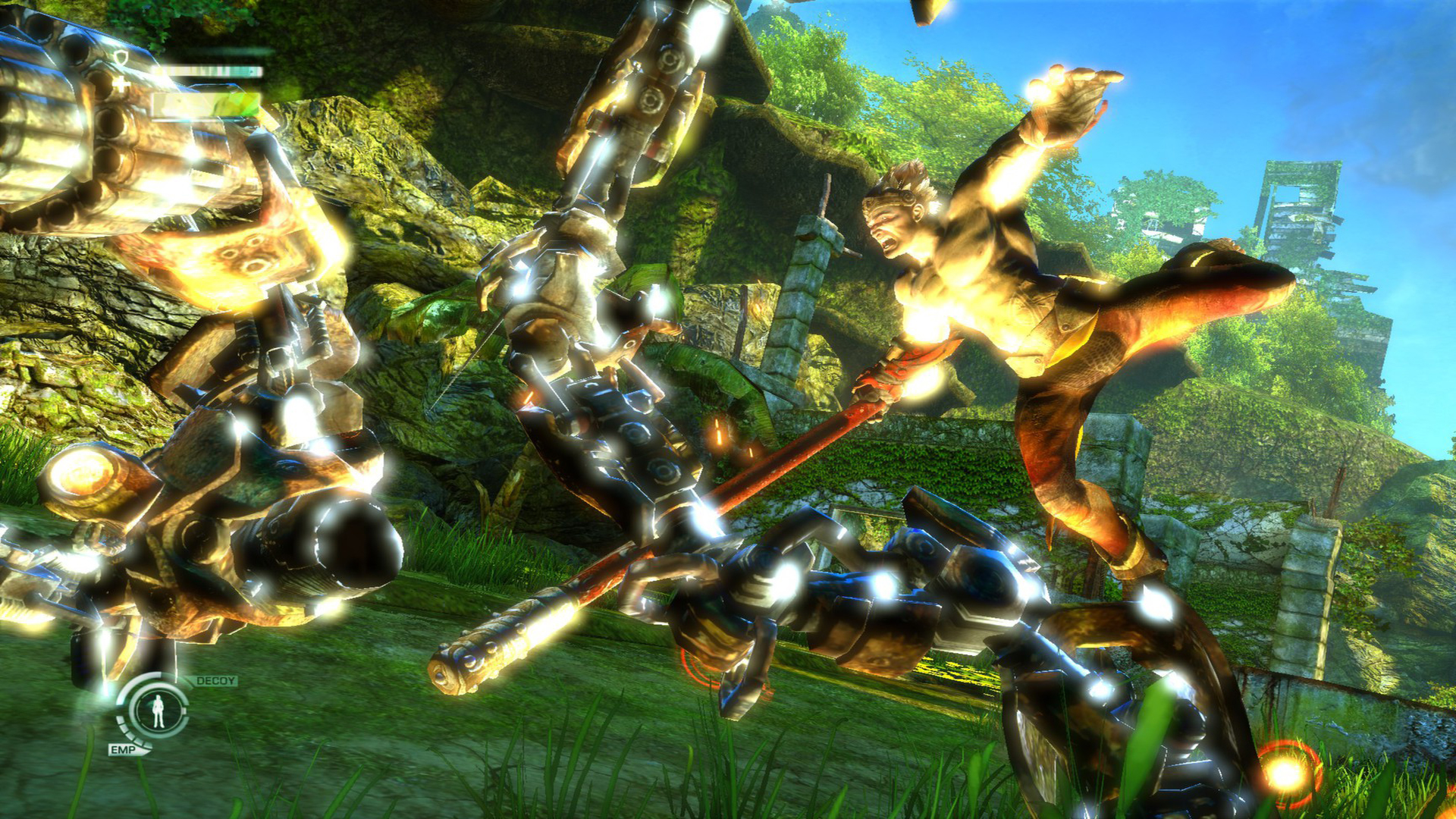
The same applies to combat. The ferocity with which Monkey smashes mechs to pieces is explained in one terse line – "My parents were killed by a mech attack when I was a kid" – and if his moveset initially seems worryingly simple, it expands over time, his staff doubling as a melee and projectile weapon. Ninja Theory would develop more malleable and responsive combat systems for DmC: Devil May Cry, but there's a thrillingly primal satisfaction to the way Monkey wields his staff. As he prepares for battle, he's a coiled spring; suddenly, that internalised rage bursts forth in every blow, accompanied by rumble feedback in the controller and a loud metallic clank. What it lacks in subtlety, it compensates for in sheer audiovisual force, heightened by slow-mo finishing moves as Monkey lets out a cathartic roar.
(Image credit: Ninja Theory) Nonetheless, Ninja Theory seems aware that perhaps neither the combat nor the platforming would stand up to long-term scrutiny. Thankfully, neither really has to. Light-but-engaging environmental puzzles present a welcome change of pace: a sequence where Monkey unfurls the sails of a windmill is an undoubted highlight. Later, an ostensibly straightforward climbing section is refashioned into a surprisingly challenging race. If some co-operative leverpulling sequences feel contrived in their arrangement and one or two ideas repeat themselves in the second half, there's usually a fresh context in each case – and even if not, Garland's dialogue is more than up to the metaphorical heavy lifting, while Monkey does the physical equivalent.
And when the pace does slacken, and Enslaved can't quite give us something new to keep our thumbs occupied, it usually finds a way to keep our eyes glued to the screen. When the camera's not pointing you in the right direction, it's providing artful framing for some exceptional environment design, proof that post-apocalyptic themes needn't result in palettes formed exclusively of greys, browns and sickly yellows. You get to climb twisted structures of rusted steel, intertwined with flourishing red and green flora. You can explore a mech graveyard, bounding over what looks like modernist sculpture, but at second glance appears to be a gigantic spinal column. If this is what the world looks like when nature and machinery have claimed co-ownership, perhaps we should leave them to it.
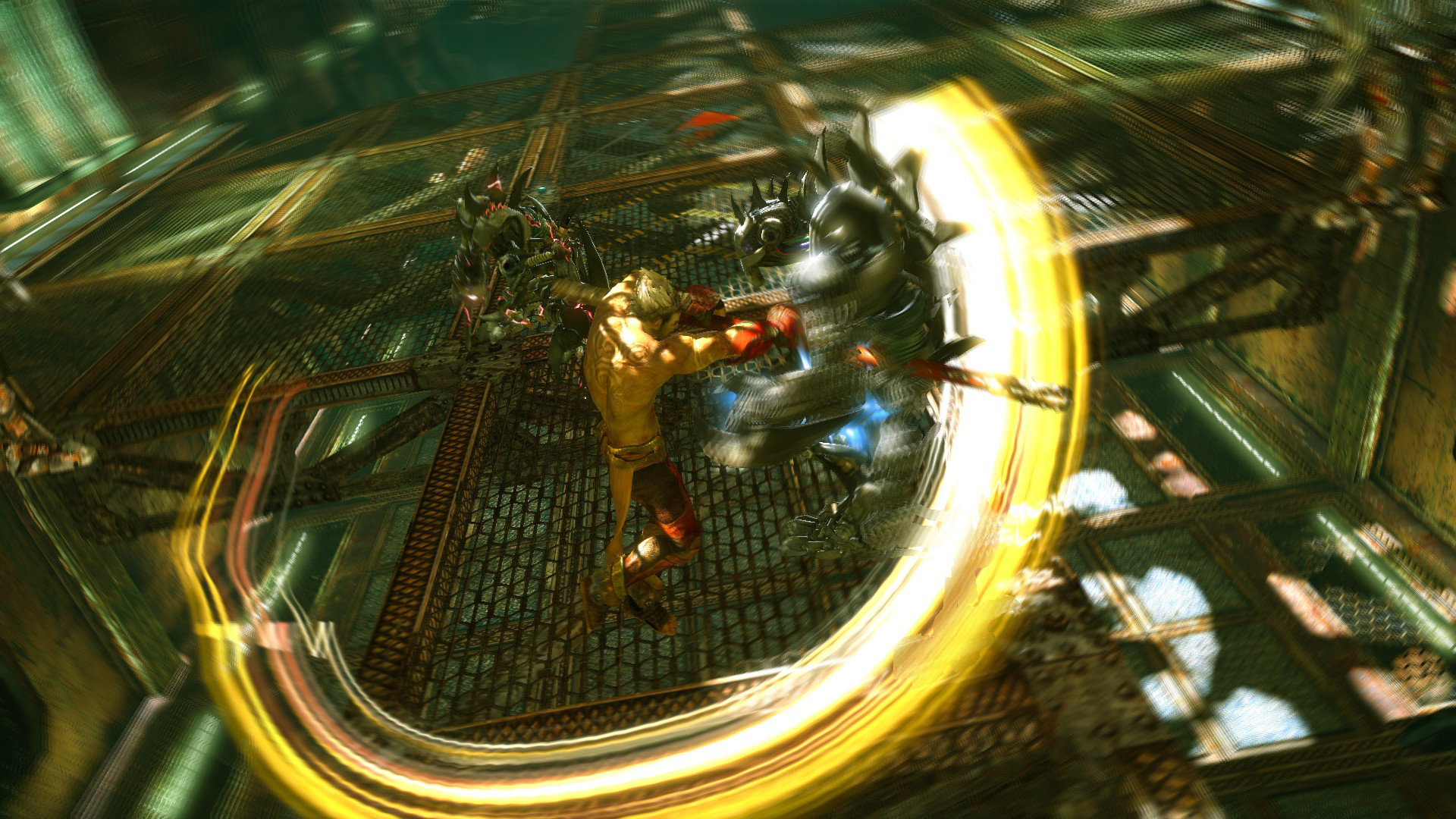
(Image credit: Ninja Theory) You get to cover a lot of ground in a relatively short time – such that by the time you reach your destination, a mere eight or so hours after the game began, it really feels like you've been on a journey.
It added up to positive reviews but, by most accepted metrics, a flop. A high-concept contemporary sci-fi title based on a literary classic from 16th-century China always felt like a tough sell, and so it proved. And yet its cultural legacy may well resonate longer than its limited initial impact. There are clear signs here of the design thrift that will serve Ninja Theory well in the forthcoming Hellblade – a blockbuster on a relative shoestring. And for all that Enslaved borrows from the Uncharted series, it's clear now that Naughty Dog owes Ninja Theory a debt in return. But then the notion of sharing ideas is rooted in a classic allegorical yarn that espouses the virtues of collaboration and mutual understanding – yes, that original Journey To The West. Who said it's nothing like the book?
This article was first published in issue 283 of Edge Magazine. If you're interested in receiving more just like this direct, subscribe to Edge Magazine.
[/url]

Jat AI
Stay informed with the latest in artificial intelligence. Jat AI News Portal is your go-to source for AI trends, breakthroughs, and industry analysis. Connect with the community of technologists and business professionals shaping the future.