





















PNY's Slimline RTX 5080 might be the best version of this graphics card for versatile PC building, and making good on those FE promises
I don't know about you, but after two generations of high-end graphics cards getting to ridiculous, gargantuan sizes, I was really optimistic when Jensen Huang revealed the RTX 5080 and 5090. Finally, I thought, some high-end GPUs that are going to be versatile enough to fit in even the smallest of PC builds. Board partners, however, did not take on Nvidia's FE inspirations, because chances are, if you're looking to buy one of the best graphics cards, you're still going to need a lot of room in your PC's case. I've always been partial to a smaller gaming PC. My first build was an ITX system. I now have an mATX rig, but I feel I'm not the only one looking for a more versatile way of slotting an RTX 5080 into a smaller chassis these days. Brands like NZXT, Fractal Design, BeQuiet, Corsair, and more are all serving an increasing market demand for smaller PC builds with mATX cases, and although you can fit larger RTX 5080s inside them, you're going to limit space for case fans and generally make your life harder if you do. That's why I was so excited about PNY's Slim RTX cards when they were revealed at CES at the start of the year. Finally, a third-party-made Nvidia GPU range that has the sizing versatility the Founders Editions promised. This range originally spanned the RTX 5070, 5070 Ti, and 5080, but it now seems there's a slimline RTX 5060 Ti out there too. Of course, since these are a niche play on the 50 Series GPUs and there are OC models available, pricing is likely to set you back more than MSRP, but is the increased versatility worth it? Specs (Image credit: Future / Duncan Robertson) The initial reaction from some might be to doubt that PNY's Slim GPUs are what they say they are, but if you look at the specs table, you'll see that everything in the 5080 is accounted for here. In fact, the model I'm testing is an overclocked version, so you'll actually see an improvement in the boost clock speed here despite its smaller footprint. RTX 5080 Founders Edition vs PNY Slim specs Model RTX 5080 PNY Geforce RTX 5080 Slim OC Price $999 / £989 MSRP $1,399-$1,299 at Amazon / £1,289 at Amazon GPU GB203 GB203 CUDA cores 10,752 10,752 Tensor cores 336 (fifth-gen) 336 (fifth-gen) RT cores 84 (fourth-gen) 84 (fourth-gen) Base clock 2,295 MHz 2,295 MHz Boost clock 2,617 MHz 2,730 MHz VRAM 16GB GDDR7 16GB GDDR7 Memory bus 256-bit 256-bit TDP 360W 360 W There has already been plenty said about the Nvidia GeForce RTX 5080's reluctance to bump up beyond 16GB of VRAM, but in truth, from plenty of hands-on time with it through PC reviews and testing this GPU out, the faster GDDR7 VRAM still gives you plenty of room to gallop at 4K resolutions. Elsewhere, there are enough cores for ray tracing and native performance that you're going to have all the power you need for 4K gaming. So what are you gaining here in the overclocked version - where is your money going? Well, an overclocked GPU essentially means that it's pre-overclocked in the factory to unleash a bit of extra performance for you without you needing to do anything. Is it a performance bump you're going to notice? Probably not massively, to tell the truth, but when you're building a smaller rig and you don't want to compromise on performance because of that, an OC version is going to ensure you're getting every frame possible. It's really up to you if the extra money will be worth it. The main question here, with a smaller board, is going to be about cooling, and that's going to put a lot of pressure on the design PNY has shot for.Design & Features (Image credit: Future / Duncan Robertson) I really like the approach PNY has taken with the slim model of the RTX 5080. It's pretty much exactly what it says on the tin. You're still getting a dual-slot GPU; it's as broad and almost as long as other high-end GPUs, but it's about half or two-thirds of the width of full-sized models. Before this, I was doing some retrospective testing on the Radeon RX 7900 XTX, and although I love that card for its native performance, its size was just utterly obnoxious to the point of it barely squeezing into my case alongside my fans. In fact, the bodywork of the fans and the GPU was such that they were actually touching. I don't have that issue in an NZXT H3 Flow case with PNY's Slim 5080. Finally, it feels like a graphics card range that's been designed with my type of PC building in mind, and the ease of installing this thing felt like a fresh breeze on a hot summer's day. (Image credit: Future / Duncan Robertson) Is the look of this GPU a bit of a plain Jane? I can't lie; yes. For how stylish smaller PCs can look, either with fishbowl mATX cases or with quirky ITX ones, you'd kind of hope that there were some aesthetic choices to be made with a slimline GPU, but I suppose beggars can't be choosers. It would be really, really nice if PNY decided to make a white version of its slim cards, just to give people a choice to match their rigs. All in all, this isn't the card to
 I don't know about you, but after two generations of high-end graphics cards getting to ridiculous, gargantuan sizes, I was really optimistic when Jensen Huang revealed the RTX 5080 and 5090. Finally, I thought, some high-end GPUs that are going to be versatile enough to fit in even the smallest of PC builds. Board partners, however, did not take on Nvidia's FE inspirations, because chances are, if you're looking to buy one of the best graphics cards, you're still going to need a lot of room in your PC's case.
 I've always been partial to a smaller gaming PC. My first build was an ITX system. I now have an mATX rig, but I feel I'm not the only one looking for a more versatile way of slotting an RTX 5080 into a smaller chassis these days. Brands like NZXT, Fractal Design, BeQuiet, Corsair, and more are all serving an increasing market demand for smaller PC builds with mATX cases, and although you can fit larger RTX 5080s inside them, you're going to limit space for case fans and generally make your life harder if you do.
That's why I was so excited about PNY's Slim RTX cards when they were revealed at CES at the start of the year. Finally, a third-party-made Nvidia GPU range that has the sizing versatility the Founders Editions promised. This range originally spanned the RTX 5070, 5070 Ti, and 5080, but it now seems there's a slimline RTX 5060 Ti out there too. Of course, since these are a niche play on the 50 Series GPUs and there are OC models available, pricing is likely to set you back more than MSRP, but is the increased versatility worth it?
Specs
(Image credit: Future / Duncan Robertson) The initial reaction from some might be to doubt that PNY's Slim GPUs are what they say they are, but if you look at the specs table, you'll see that everything in the 5080 is accounted for here. In fact, the model I'm testing is an overclocked version, so you'll actually see an improvement in the boost clock speed here despite its smaller footprint.
RTX 5080 Founders Edition vs PNY Slim specs
There has already been plenty said about the Nvidia GeForce RTX 5080's reluctance to bump up beyond 16GB of VRAM, but in truth, from plenty of hands-on time with it through PC reviews and testing this GPU out, the faster GDDR7 VRAM still gives you plenty of room to gallop at 4K resolutions. Model
RTX 5080
PNY Geforce RTX 5080 Slim OC
GPU
GB203
GB203
CUDA cores
10,752
10,752
Tensor cores
336 (fifth-gen)
336 (fifth-gen)
RT cores
84 (fourth-gen)
84 (fourth-gen)
Base clock
2,295 MHz
2,295 MHz
Boost clock
2,617 MHz
2,730 MHz
VRAM
16GB GDDR7
16GB GDDR7
Memory bus
256-bit
256-bit
TDP
360W
360 W
Elsewhere, there are enough cores for ray tracing and native performance that you're going to have all the power you need for 4K gaming. So what are you gaining here in the overclocked version - where is your money going?
Well, an overclocked GPU essentially means that it's pre-overclocked in the factory to unleash a bit of extra performance for you without you needing to do anything. Is it a performance bump you're going to notice? Probably not massively, to tell the truth, but when you're building a smaller rig and you don't want to compromise on performance because of that, an OC version is going to ensure you're getting every frame possible. It's really up to you if the extra money will be worth it.
The main question here, with a smaller board, is going to be about cooling, and that's going to put a lot of pressure on the design PNY has shot for.
Design & Features
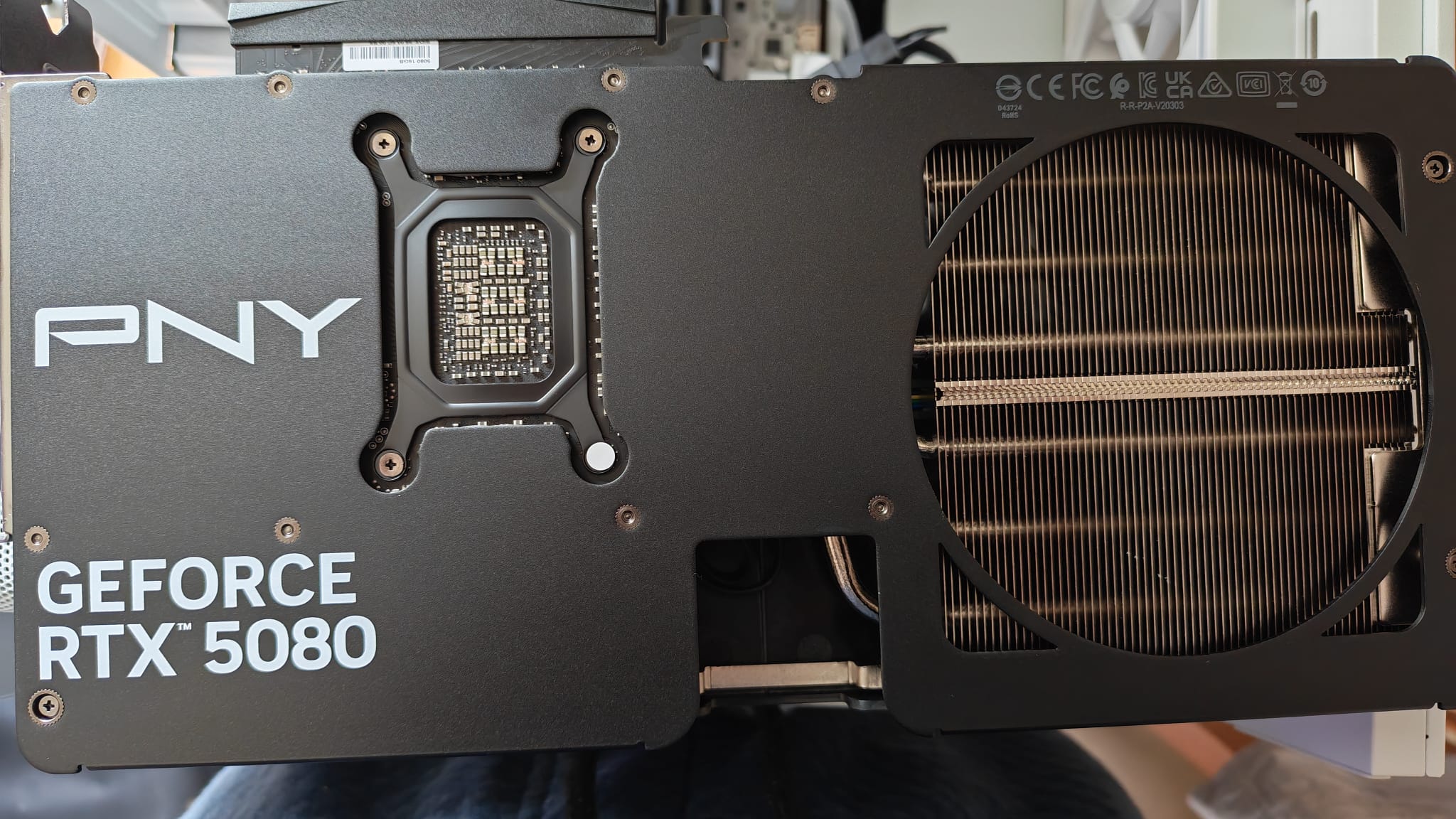
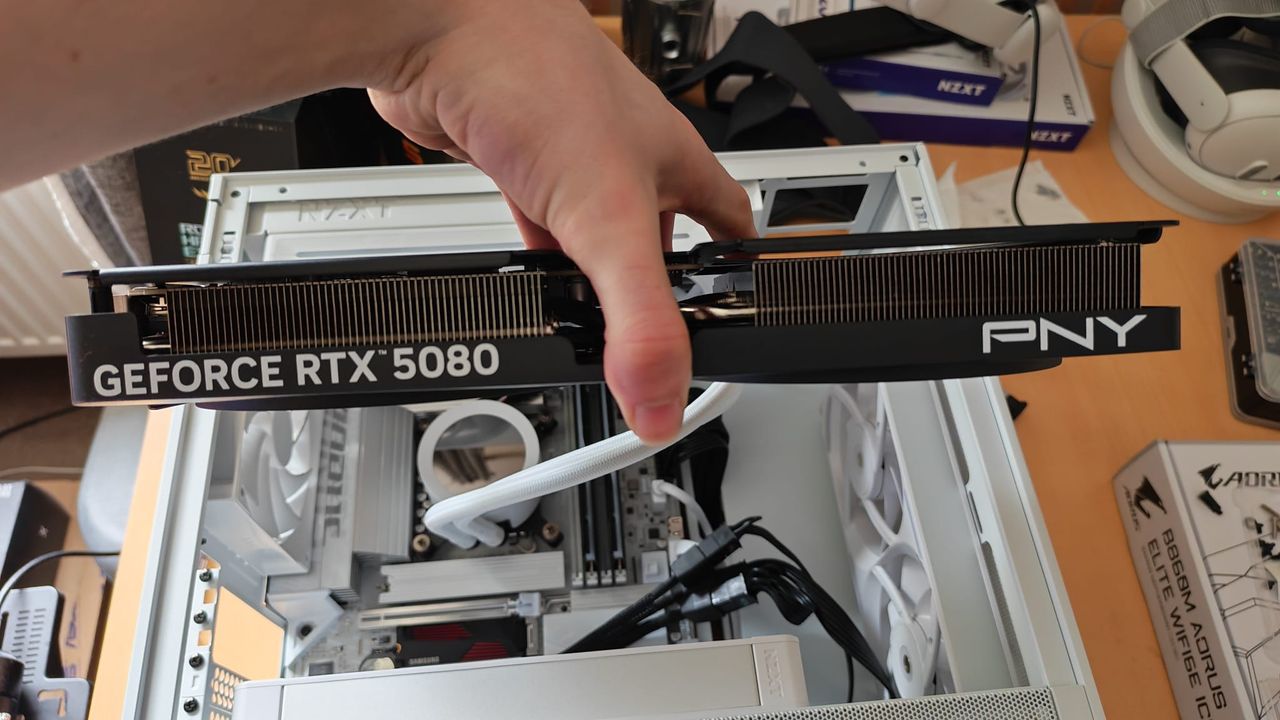
(Image credit: Future / Duncan Robertson) I really like the approach PNY has taken with the slim model of the RTX 5080. It's pretty much exactly what it says on the tin. You're still getting a dual-slot GPU; it's as broad and almost as long as other high-end GPUs, but it's about half or two-thirds of the width of full-sized models. Before this, I was doing some retrospective testing on the Radeon RX 7900 XTX, and although I love that card for its native performance, its size was just utterly obnoxious to the point of it barely squeezing into my case alongside my fans. In fact, the bodywork of the fans and the GPU was such that they were actually touching.
I don't have that issue in an NZXT H3 Flow case with PNY's Slim 5080. Finally, it feels like a graphics card range that's been designed with my type of PC building in mind, and the ease of installing this thing felt like a fresh breeze on a hot summer's day.
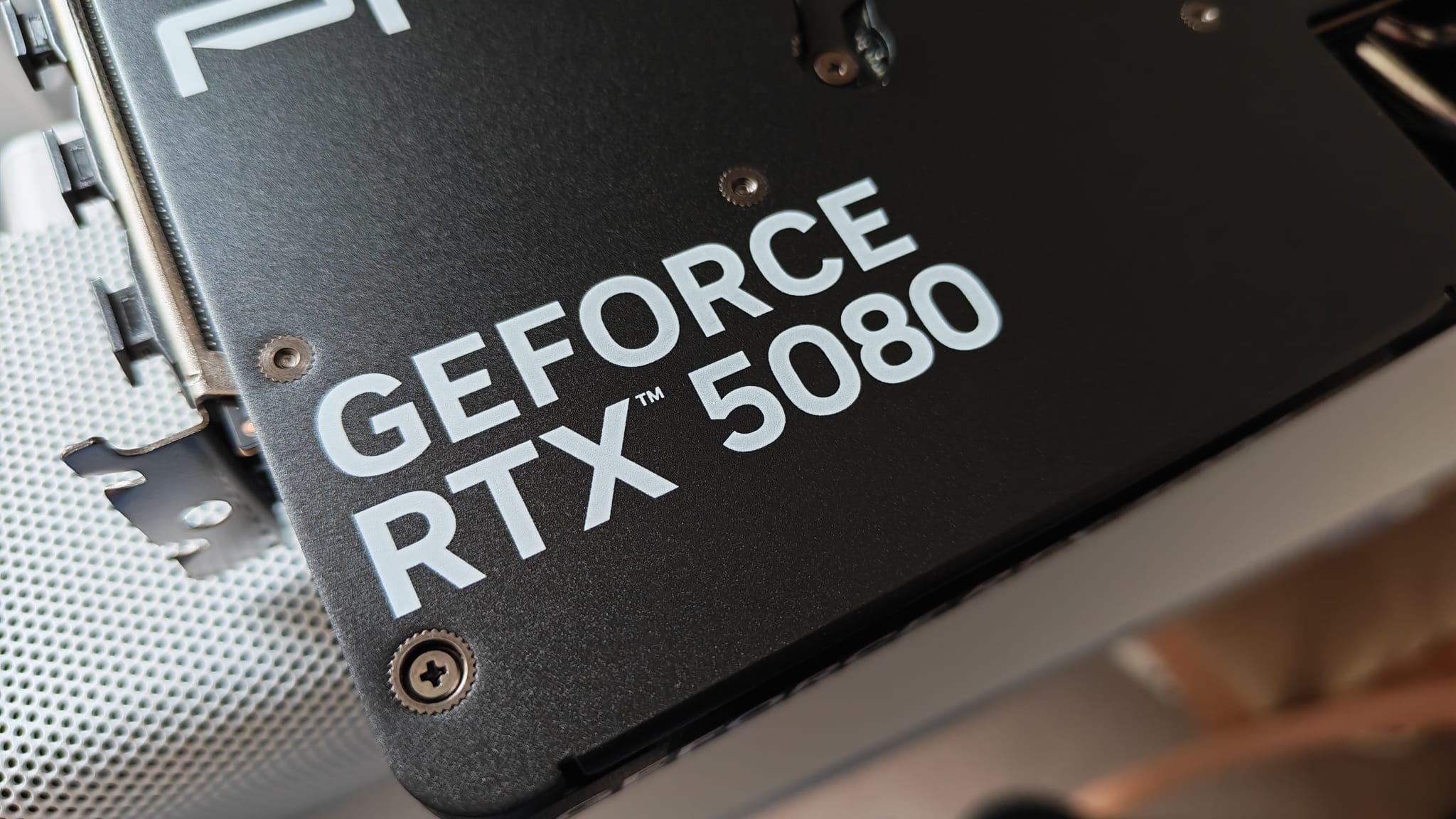
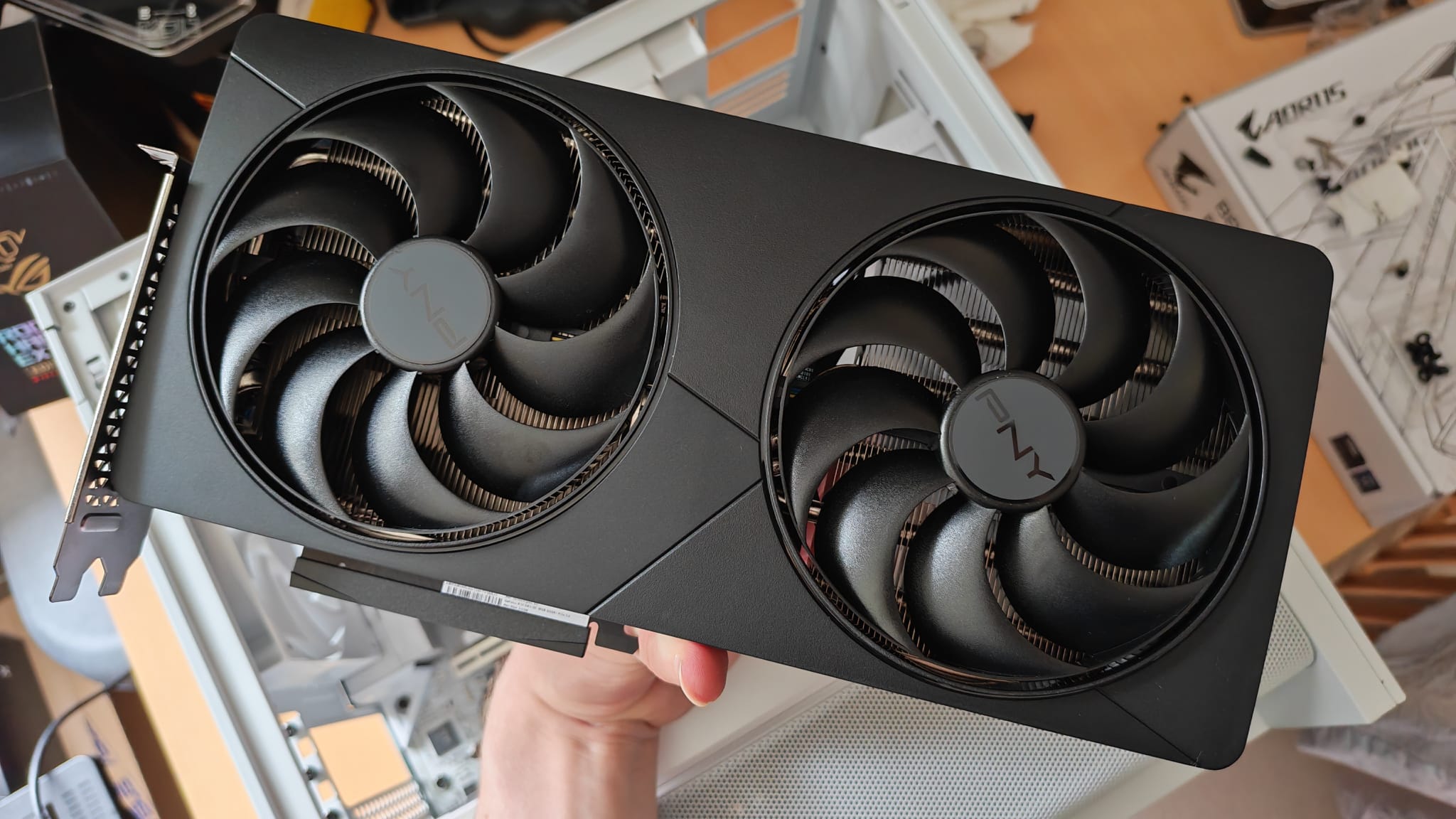
(Image credit: Future / Duncan Robertson) Is the look of this GPU a bit of a plain Jane? I can't lie; yes. For how stylish smaller PCs can look, either with fishbowl mATX cases or with quirky ITX ones, you'd kind of hope that there were some aesthetic choices to be made with a slimline GPU, but I suppose beggars can't be choosers. It would be really, really nice if PNY decided to make a white version of its slim cards, just to give people a choice to match their rigs.
All in all, this isn't the card to go for if you're wanting a stylish gamer look inside your PC, but then again, I do like the no-nonsense feel PNY has gone for, and the somewhat retro, bold branding has some charm to it. Hey, at least it fits in the case and doesn't look cramped inside, right?
The important part is going to be thermals, which I'm glad to say PNY has clearly thought about. Instead of opting for a longer card with three fans, it's opted for a size of 300 x 150 x 40mm (11.8" x 5.9" x 1.6"), which makes it a bit shorter, but leaves room for two 120mm fans. You can also see inside the innards of the board that there's a vapor chamber that spans almost its entire length and width. There's plenty of scope for heat dissipation here.
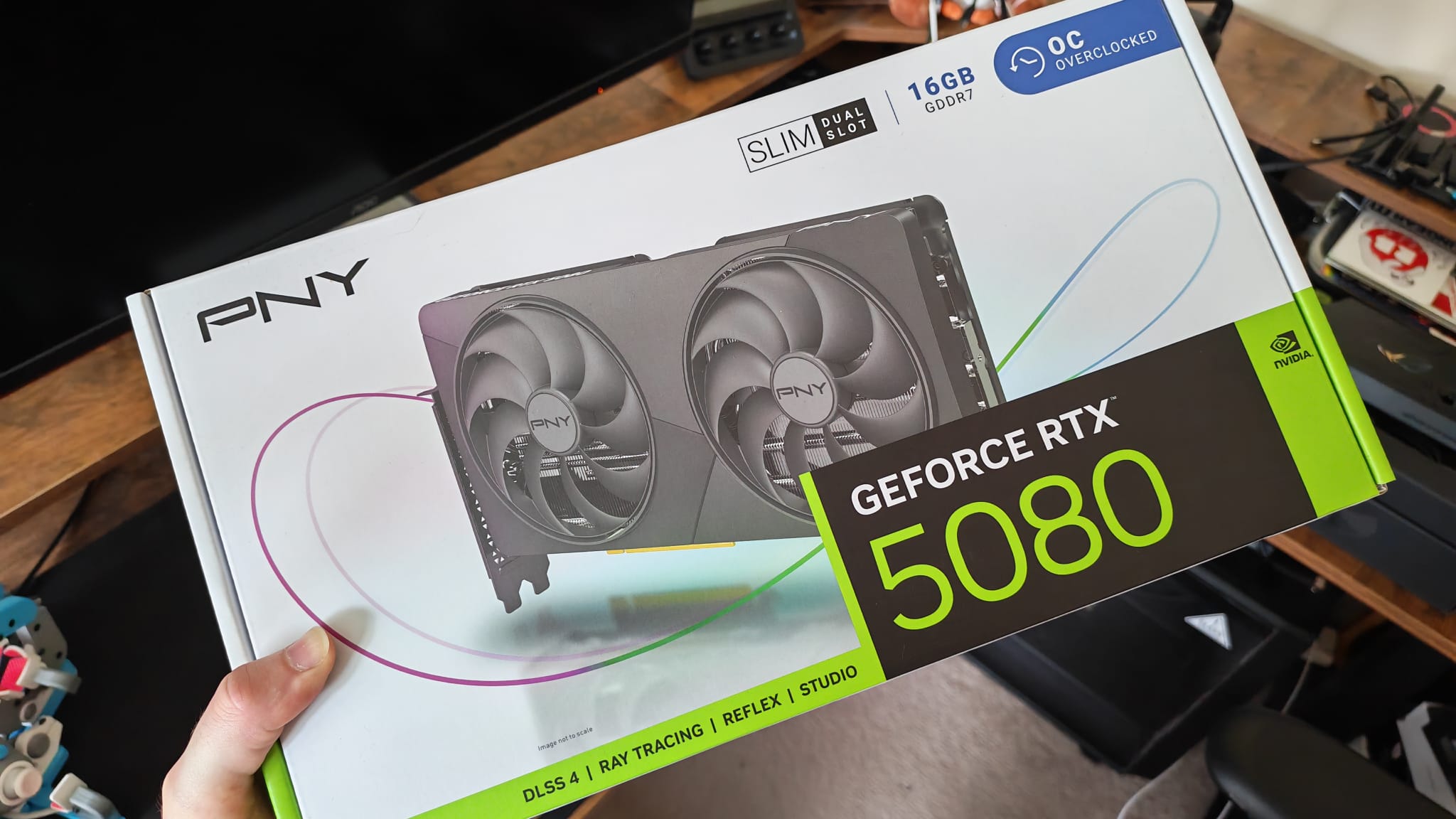
(Image credit: Future / Duncan Robertson) Of course, beyond its full range of power courtesy of Nvidia's specs, it is going to feature the full bag of DLSS magic tricks. Improved on since launch, this now includes DLSS 4.5, Dynamic Multi-Frame Gen, and Ray Reconstruction. As is always the case, your mileage with these will vary based on the games that have compatibility with them. Of the games I've been testing out for this review, Crimson Desert and 007 First Light both have great settings menus with access to Dynamic MFG and the latest transformer models for DLSS. These definitely make an improvement over my latency issues with MFG, but there are still screen-tearing and fps choppiness issues, in Crimson Desert especially, that seem to appear when I'm using all of these in combination.
Either way, with an RTX 5080, you're going to have enough of a feature set to switch on Ray Tracing and full settings and toggle DLSS tools as needed. There's also a degree of futureproofing here, and I'd be surprised if whatever monstrosity DLSS 5 turns out to be, it wasn't included on 50 Series boards like this.
Performance
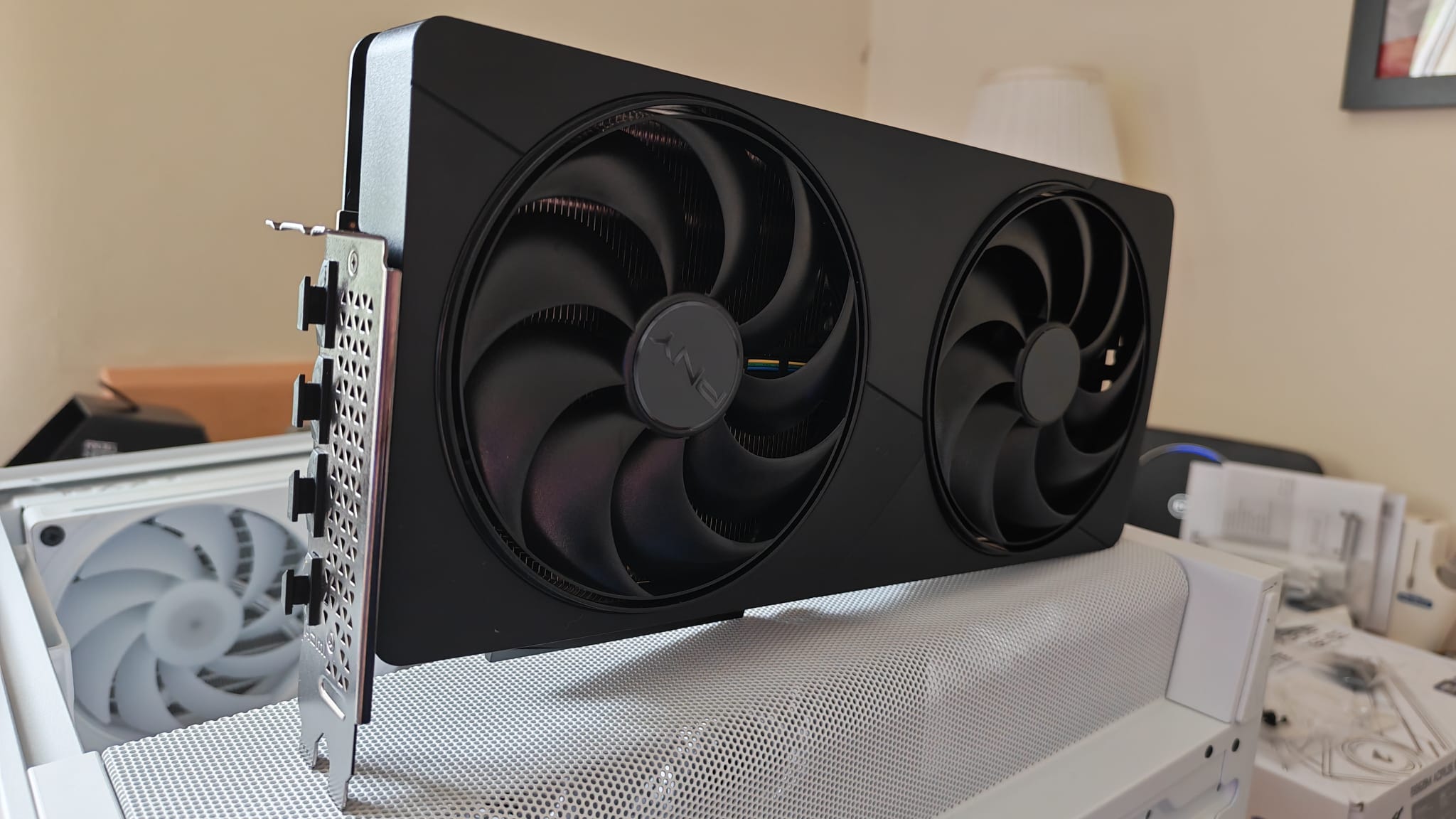
(Image credit: Future / Duncan Robertson) Besides this, I do have a lot of hands-on time with the RTX 5080, both inside the NZXT Player Three 5080 Edition and the latest Acer Predator Orion 7000. These are going to form the baseline for my testing out the PNY Slimline version of the card, because I think the question on everyone's mind is whether or not a smaller design, two larger fans as opposed to three, and less space inside for cooling will hamper an RTX 5080's gaming power.
To cut right to it, I'll say that that isn't the case. In comparison with the full-sized RTX 5080, you're not going to be losing out on frame rates here. Granted, I've tested these GPUs across three different systems and with varying CPUs, but for the most part, all three PCs are equipped for 4K gaming, and you're highly unlikely to beat-for-beat match any of their specs anyway, so if anything comparing across all three systems is going to give you a broader sense of typical performance for the 5080, versus PNY's smaller version.
Kicking things off, I want to talk about thermals. 3DMark's benchmarking tests can be a stern test for CPUs and GPUs when they get to their most demanding moments. I've seen graphics cards in the highest-end gaming PCs reach the mid-to-high 70s and CPUs reach boiling point, and yet the Slim RTX 5080 never surpassed 66 degrees. With two 120mm fans and that massive vapor chamber, I really don't think there's much to worry about here in terms of overheating due to a smaller footprint. I've kept a close eye on thermals while benchmarking, and I've never seen the GPU jump up to temperatures that concern me. As an added bonus, even when those larger fans are kicking up, I don't hear a lot of increased noise coming from my machine.
https://flo.uri.sh/visualisation/29706303/embed Then we come to the actual 3DMark benchmarking scores. In Time Spy, the slimline RTX 5080, combined with an Intel Core Ultra 5 250K Plus in this review, scored a very impressive 28,500. That beats both the NZXT Player Three and Acer Predator Orion 7000 versions, which scored 27,348 and 27,915, respectively. Granted, these scores were done over a year ago, so they were tested on older drivers. Even so, the CPUs paired with them were the AMD Ryzen 7 9800X3D and the original Intel Core Ultra 7 256KF, so matched against the latest Core Ultra 5, they should be up to the challenge.
Clearly, PNY's overclocking has pulled some extra performance out of the bag here. In our original review of the RTX 5080, that compares to a score of 32,416 in Time Spy, so maybe there is some better 5080 gaming performance out there in larger models, but these scores are all pretty close-knit - you're probably not going to notice massive differences in real-world gaming frame rates between them all.
Similarly, in Fire Strike and Steel Nomad, the PNY 5080 Slim scored 50,251 and 87.24, respectively. This beats the scores of the Acer Predator Orion (45,728 / 85.73) and our original 5080 review (43,878), but falls to the NZXT Player Three, which won in Fire Strike with a score of 55,985, but a Steel Nomad score of only 78.31. Across the board, the PNY 5080 is making a real case for itself as a strong version to go for.
Then we come to real-world gaming tests.
https://flo.uri.sh/visualisation/29706533/embed In the widget above, I've copied in some benchmarking figures from the PC reviews I've mentioned above to keep comparisons flowing. Again, I'd ask you to take note of the fact that these are all tested across different systems with different processors and what have you, but they should put to rest any doubts that a more compact form factor in the PNY RTX 5080 Slim is going to hamper your gaming benchmarks. This thing is every bit as effective at rendering games at high resolutions and frame rates as any of the other RTX 5080s I've gone hands-on with.
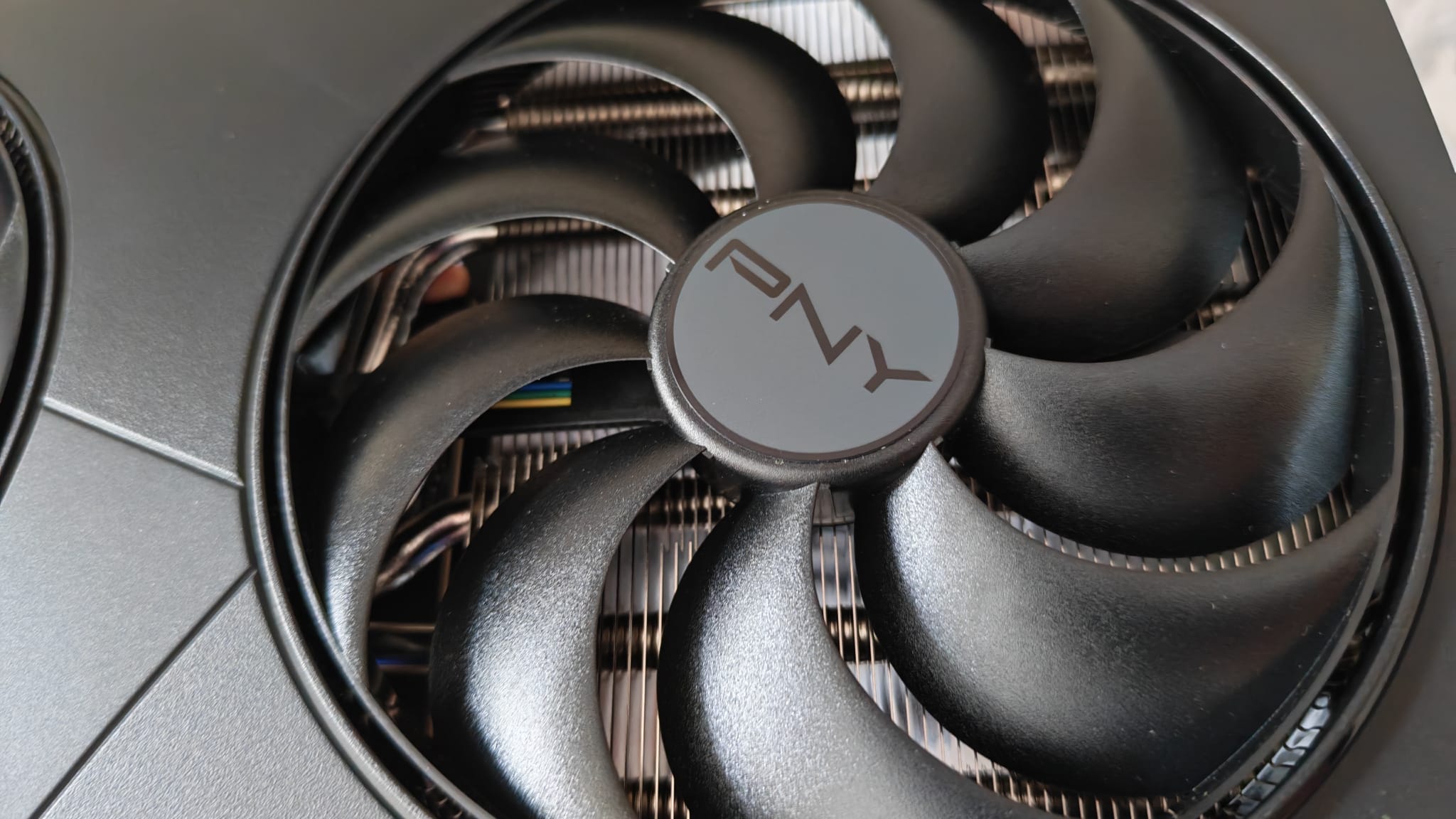
(Image credit: Future / Duncan Robertson) I think one of the things I'm taking away from those benchmarking figures is that across the board, the PNY RTX 5080 Slim outperformed the Acer Predator Orion, which is especially impressive given the processors used in each build. Maybe that speaks to Intel's latest generation of desktop CPUs more than it does the disparity in performance between the varying RTX 5080s, but it does show that, paired with the correct components, PNY's versatile set of slimline graphics cards is capable of being excellent in the 4K gaming trenches. Of course, I've been carrying out the PNY tests with updated drivers and DLSS wizardry compared to the review of Acer's flagship desktop rig, so that's also a caveat.
With those updated drivers comes access to enhanced multiframe gen trickery, which I'm now more open to since Dynamic Multi-Frame Gen arrived on the scene. I tested this in Crimson Desert and 007 First Light, and I found that the floaty, annoying latency that I was experiencing with MFG before was lessened to the point that it didn't bother me. I did notice a higher tendency for it to cause screen tearing, both with and without V-sync in the mix. I'd still like an enhanced form of Reflex at some point to really allow MFG to run free without latency issues, especially for lower-grade 50-series cards that rely on it.
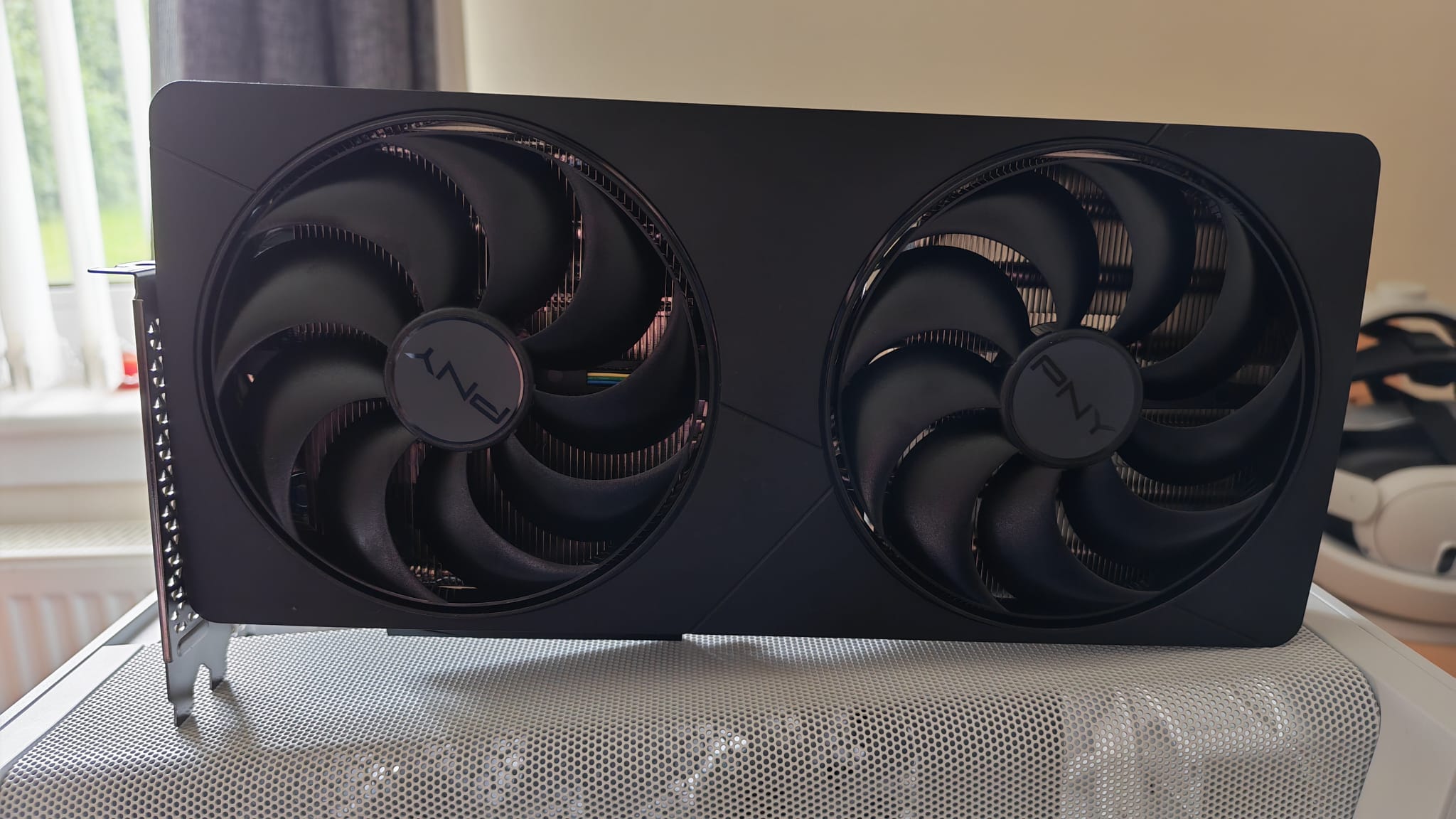
(Image credit: Future / Duncan Robertson) In any case, you're not going to need to lean on DLSS as much with the RTX 5080 since it has a bit more native 4K power. I haven't recorded frame gen benchmarks for this review since we've looked into that in previous 5080 reviews, like PNY's larger OC model. But with gaming monitors getting faster and faster, just know that MFG is going to be your key to maxing out refresh rates as time goes on.
What's great about the 5080 compared to the 5070/Ti is that you can afford to play with Ray Tracing a lot more freely. From hands-on time with plenty of current-gen 4K GPUs, I'd highly recommend the freedom the RTX 5080 can give you if your budget allows. It's the one that makes those DLSS magic tricks feel like additional tools on your utility belt, not must-use features to get your desired frame rates.
In terms of building performance, the PNY RTX 5080 Slim couldn't be easier to use. I put it to work inside my NZXT H3 Flow case for this review (an mATX chassis), and I found it doesn't even need a support bracket to prop it up because its weight is distributed so cleanly.
Should you buy the PNY RTX 5080 OC Slim?
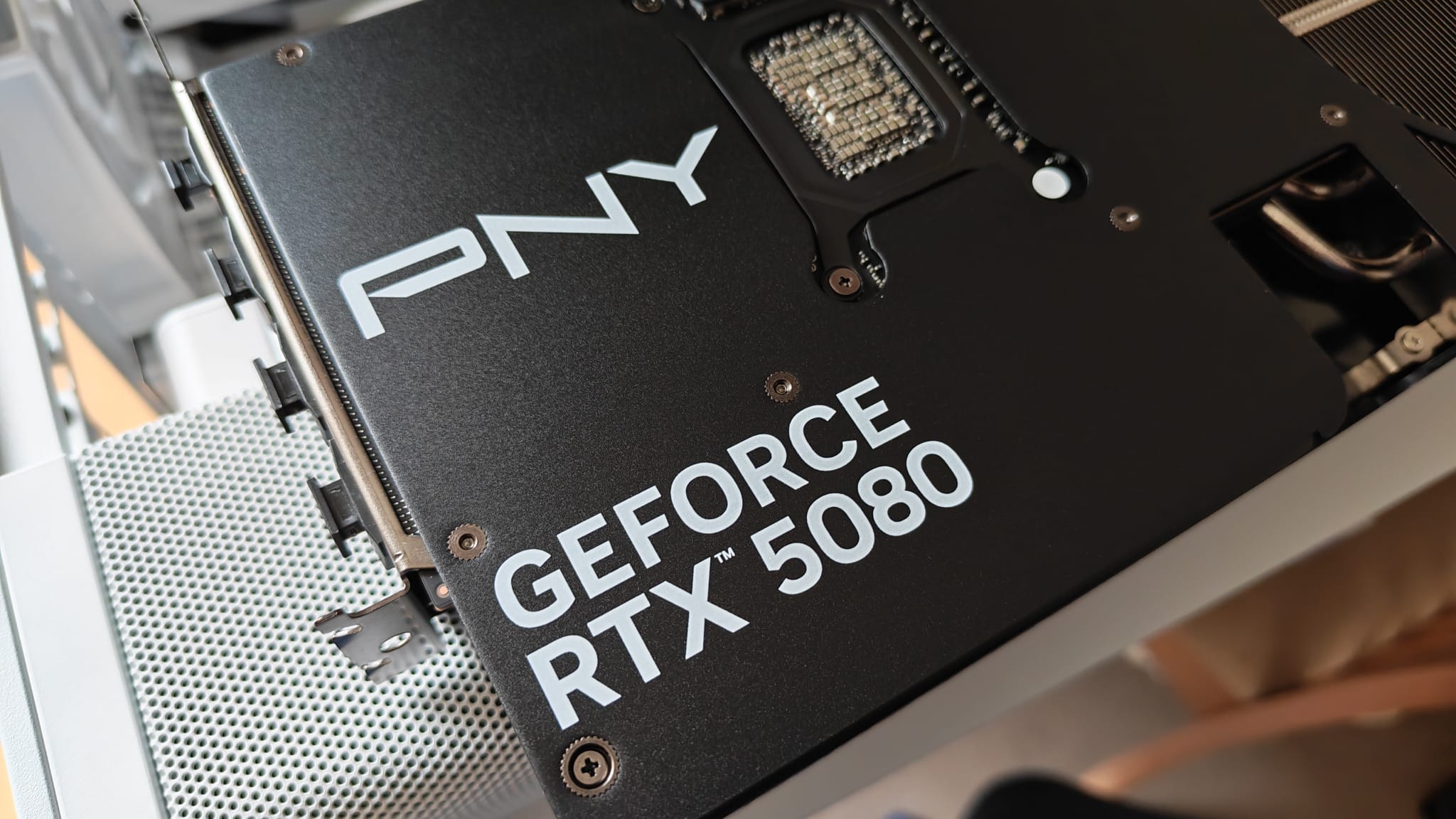
(Image credit: Future / Duncan Robertson) For anyone like me, who has dreams of building a powerhouse 4K gaming PC in a smaller case, without frame rate compromises, I cannot recommend the PNY RTX 5080 OC Slim more highly. This GPU is one of the easiest high-end cards I've built with, and its smaller footprint clearly doesn't mean you need to accept any frame rate hold-backs. From my hands-on testing, it's every bit as powerful as other full-sized RTX 5080 graphics cards; it's just lighter, more versatile and compatible with a wider range of cases, and it has a bit more of a no-nonsense look.
Of course, the price may be an issue since the entire range of PNY Slim cards is proving popular, and the OC model is the only one I can see in stock in the US and UK. If you can get the non-OC model to save yourself some money, I would point to that. On the other hand, I can't see any other board partner making this kind of lighter-weight, smaller form factor version of Nvidia's 50 Series products.
I'd argue that from a building standpoint, the versatility and safety of one of these Slim cards is worth it. The larger fans do their job from a thermal standpoint, and even the 5080 will likely squeeze itself into a quirky ITX case if you need it to. If you had dreams of affording an FE RTX 5080, you'll be all out of luck today, but PNY's Slimline options might just be the next best thing.
How I tested the PNY GeForce RTX 5080 OC Slim
I put the Slim model of the RTX 5080 to work inside my own gaming PC and have been using it as my daily driver for over a month now. In that time, I've used it for all of my gaming, spanning all sorts of gaming genres. I've also carried out more formal benchmarking and testing, like 3DMark's benchmarks, as well as tests in some of our favorite demanding games for PC testing. I compared my results closely to the ones I found when reviewing other gaming PCs with RTX 5080s inside them, but also kept in mind that the results wouldn't be completely empirical due to driver updates and differing build discrepancies.
For more on how we test gaming PCs, take a look at the GamesRadar+ hardware policy.
For more, read up on the best CPUs for gaming, the best RAM for gaming, and the best computer speakers.
[/url]

Jat AI
Stay informed with the latest in artificial intelligence. Jat AI News Portal is your go-to source for AI trends, breakthroughs, and industry analysis. Connect with the community of technologists and business professionals shaping the future.