















Claude Opus 5.5 is now available on AWS
Claude Opus 5.5, Anthropic's most capable Opus model for agentic coding, knowledge work, and long-running tasks, is now available on Amazon Bedrock and Claude Platform on AWS. This post covers what's new in Opus 5.5, practical guidance, and how to start building with the model on Amazon Bedrock.
Today, we’re excited to announce the availability of Claude Opus 5.5 on Amazon Bedrock and Claude Platform on AWS, the first of the Claude 5.5 model family. Claude Opus 5.5 is Anthropic’s most capable Opus model suitable for agentic coding, knowledge work, and long-running tasks.
This post covers Claude Opus 5.5’s improvements, practical guidance, and how to start building with the model on Amazon Bedrock.
What makes Claude Opus 5.5 different
According to Anthropic, Claude Opus 5.5 does more with fewer tokens than Claude Opus 5, and new pricing passes those gains straight to customers. Lower per-token prices and much cheaper cache reads stack on top of the efficiency gains. The result is an average lower cost per task than Claude Opus 5, so teams can run more ambitious agentic work at scale.
Claude Opus 5.5 is trained to communicate more clearly. As it works, it surfaces what it did, what it found, and what it needs, making long-running tasks easier to follow. Adaptive thinking is always on, and Opus 5.5 decides how much reasoning each task needs. You can use effort as your control instead of manual thinking budgets.
Claude Opus 5.5 is the first Opus model that comes with safety classifiers similar to Claude Fable 5.1 in biology, cyber security, and AI development. Requests will be refused more frequently as compared to previous Opus versions.
Use cases
Claude Opus 5.5 capabilities are a good fit for industries where consistency and depth matter most. In software development, Opus 5.5 is an improvement over Opus 5 for longer-running sessions with clear communication and explainability, making it easier to use, review, and trust. For knowledge work, it requires fewer corrections compared to Opus 5 while working with and creating long documents and reports.
Getting started with Claude Opus 5.5 on Amazon Bedrock
To try Claude Opus 5.5, open the Amazon Bedrock console, choose Test, then Playground, and select Claude Opus 5.5 as the model. From there, you can run a prompt directly against it.
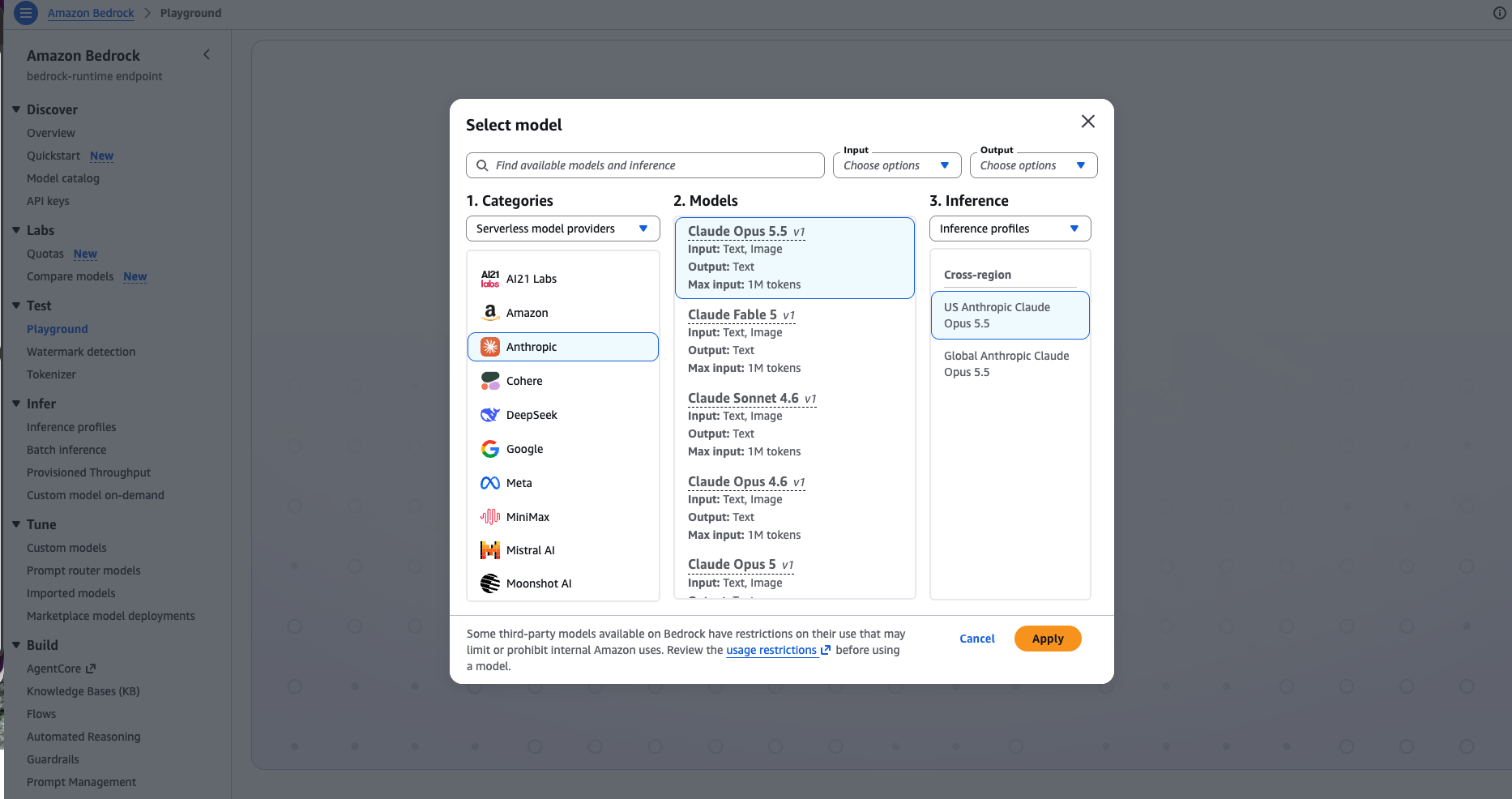
Figure 1: Selecting an Anthropic Claude model in the Amazon Bedrock console Playground
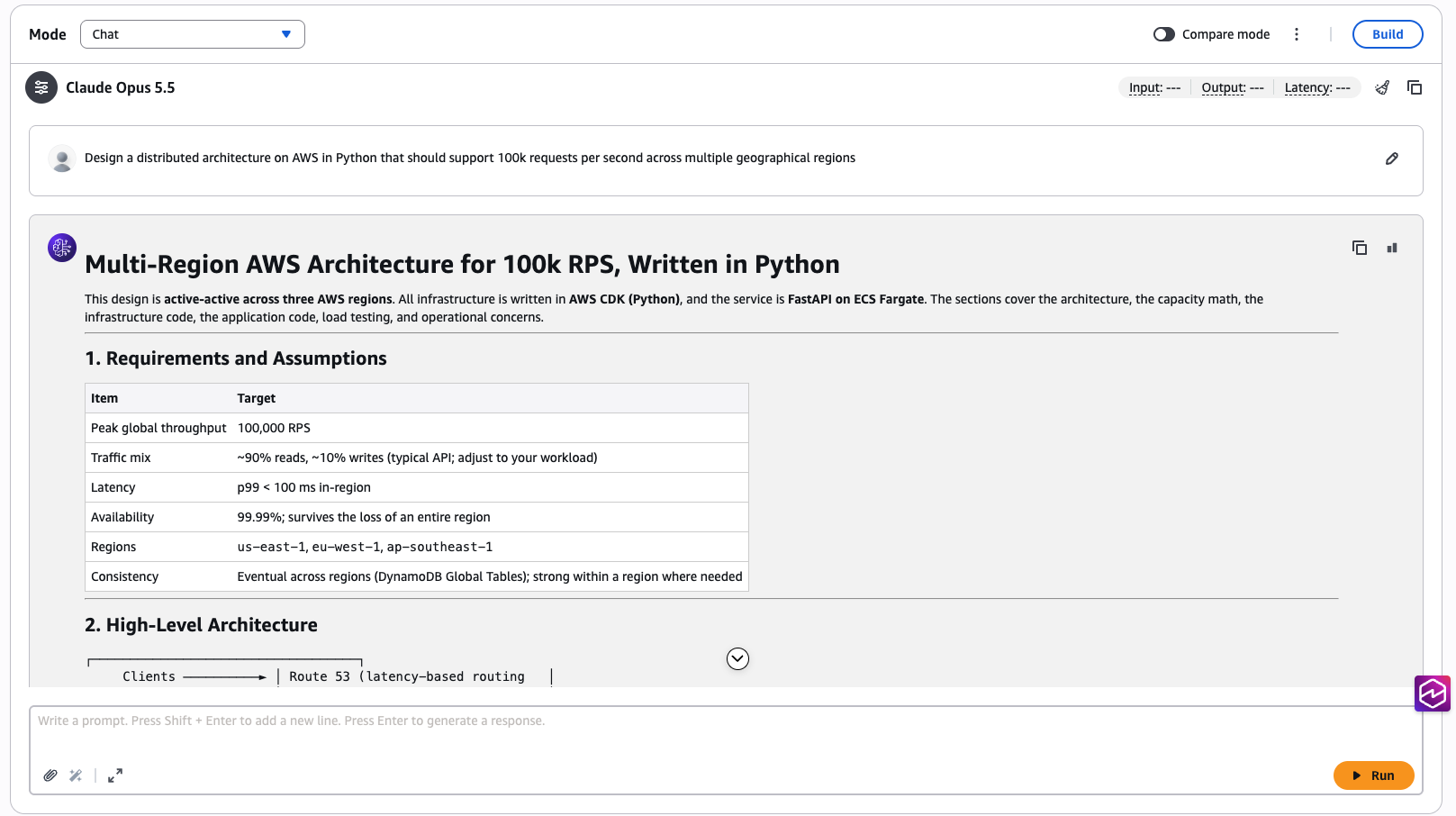
Figure 2: Running a prompt against a Claude model in the Amazon Bedrock console Playground
Programmatically, you can call the model with the Anthropic Messages API against bedrock-runtime and bedrock-mantle (through the Anthropic SDK). You can also stay on the Invoke and Converse APIs on bedrock-runtime through the AWS Command Line Interface (AWS CLI) and AWS SDK.
Prerequisites
- Active AWS account with Amazon Bedrock access.
- AWS Command Line Interface (AWS CLI) installed and configured.
- Python 3.10+.
- Boto3 installed:
pip install boto3. - Anthropic SDK installed:
pip install anthropic. - The Amazon Bedrock Token Generator for Amazon Bedrock authentication installed:
pip install aws_bedrock_token_generator. - AWS Identity and Access Management (IAM) permissions:
bedrock:InvokeModelandbedrock:InvokeModelWithResponseStream.
Here’s a quick example using the AWS SDK for Python (Boto3):
You can also use the Amazon Bedrock Converse API for a unified multi-model experience:
You can also use the Anthropic Messages API through the anthropic SDK package for a streamlined experience:
You can explore the Getting Started notebook for more examples. You can monitor usage, performance, and costs through Amazon CloudWatch and AWS Cost Explorer to scale your applications as demand grows.
Availability
Claude Opus 5.5 is available today on Amazon Bedrock through the US Geo CRIS (us.), EU Geo CRIS (eu.), AU Geo CRIS (au.), JP Geo CRIS (jp.) and Global CRIS (global.) inference profiles on bedrock-runtime. The model also runs in the US East (N. Virginia) Region (us-east-1), AP SouthEast (Melbourne) Region (ap-southeast-4) on bedrock-mantle.
See the Amazon Bedrock documentation for the full list of supported Regions. For pricing information, see Amazon Bedrock pricing. It is also available through Claude Platform on AWS in North America.
Give Claude Opus 5.5 a try in the Amazon Bedrock console, in Claude Platform on AWS, or explore the Getting Started notebooks on GitHub.
About the authors