



















How an indie spy game made turn-based tactics relentlessly exciting
Cleverly, Invisible Inc is a balance of contrasts, a yin-yang structure of opposing forces that combine in harmony. As a turn-based strategy game, it wants you to take as long as you need to make your decisions, yet also demands precision timing. It wants to retain an element of risk in every act, but removes the genre's characteristic percentages and dice rolls. It wants you to have all the info you need to make your next move, while ensuring every mission is an unknowable challenge. It wants Roguelike replayability, without the brevity or abruptness of most Roguelike campaigns. The foundation for all this is a focus on stealth. Invisible, a hi-tech private espionage outfit in the late 21st century, finds itself hunted by a group of powerful companies. You control its remaining agents as they infiltrate a series of corporate facilities to acquire info, money, and equipment. Keep surviving and gathering resources long enough, and you get a chance to enter the enemy's HQ and take their systems offline. Until then, you spend your time sneaking around offices, labs, and bank vaults, avoiding guard patrols and hacking security systems to meet various objectives. (Image credit: Klei Entertainment) The first contrast is between the familiar and the new. You start with two characters (you can rescue further operatives along the way) whose movements around grid-based locations are governed by AP, or action points. Following basic stealth protocols, you stay in cover, look ahead before you advance, and only engage guards as a last resort. But there's already another crucial resource to consider: power. You won't get far unless you remotely disable security cameras, drones, and laser grids, or access locked workstations and safes. And you can't do that if you don't maintain your power supply by activating replenishment programs or leeching from on-site terminals. When it comes to the rules and flow of play, Invisible Inc revolves around simultaneous extremes of transparency and opacity, or information that is either remarkably abundant or completely absent. First there's what you don't know. When you start one of the procedurally generated missions, the facility's layout is a mystery. You teleport into an empty square room with one or more doors; beyond that, somewhere there's your main objective, and somewhere there's the exit. Guards could be anywhere, either about to walk in on you or patrolling deeper into the complex. You'll have to figure it all out as you move. (Image credit: Klei Entertainment) As for what you do know, the rule is that once you can see something, intel on it is instant and comprehensive. This is a carryover from Klei Entertainment's previous game, Mark of the Ninja, where line of sight immediately clarifies the status of objects and enemies. Here, in a turn-based world, the concept goes a step further. If a guard is visible, you can read about any armor or special abilities he has, and perceive his exact cone of vision. Use an action point, and you can even check the path of his next move. With this knowledge, your fragile but resourceful characters can assume control. Walk through a guard's peripheral vision on your way to cover, for example, and his attention will turn to that spot, giving you a window to sneak up and rifle through his pockets or escape unseen. The simple and predictable nature of the AI is part of the game's drive to eliminate ambiguity. Even combat, when it does occur, is strictly binary. Either you have a weapon that can knock out or kill a particular guard, or you don't, and if you attack, the result is guaranteed. You never have to second-guess what the enemy will do and you never have to think about probabilities. You merely have to choose from the many possibilities laid out in front of you. Surprises only occur when you blunder forward blindly, or fail to consider what you've been told. The bells are ringing (Image credit: Klei Entertainment) This absolute transparency, coupled with the contemplative nature of turn-based play, suggests cool, methodical advancement. But again that's only the half of it. The other half is urgency, pressure and panic, and it mostly comes from a single cause: the alarm level. The big twist in Invisible Inc is that while you arrive in each facility undetected, the enemy security network becomes more alert to your presence after every turn, and introduces new threats at certain thresholds – extra cameras, increased firewalls, more guards. Also, any time you get spotted, hack a booby-trapped system or use lethal force, the level jumps up even more. The longer you hang around and the more mistakes you make, the harder it is to get anything done. The most precious commodity thus isn't AP or power, but turns themselves. While you don't have to worry whether or not an action will succeed, you must consider its efficiency. Any decision can have a vital fallout in terms of time that will alter how the mission unfolds. Do you split your
 Cleverly, Invisible Inc is a balance of contrasts, a yin-yang structure of opposing forces that combine in harmony. As a turn-based strategy game, it wants you to take as long as you need to make your decisions, yet also demands precision timing. It wants to retain an element of risk in every act, but removes the genre's characteristic percentages and dice rolls. It wants you to have all the info you need to make your next move, while ensuring every mission is an unknowable challenge. It wants Roguelike replayability, without the brevity or abruptness of most Roguelike campaigns.
 The foundation for all this is a focus on stealth. Invisible, a hi-tech private espionage outfit in the late 21st century, finds itself hunted by a group of powerful companies. You control its remaining agents as they infiltrate a series of corporate facilities to acquire info, money, and equipment. Keep surviving and gathering resources long enough, and you get a chance to enter the enemy's HQ and take their systems offline. Until then, you spend your time sneaking around offices, labs, and bank vaults, avoiding guard patrols and hacking security systems to meet various objectives.
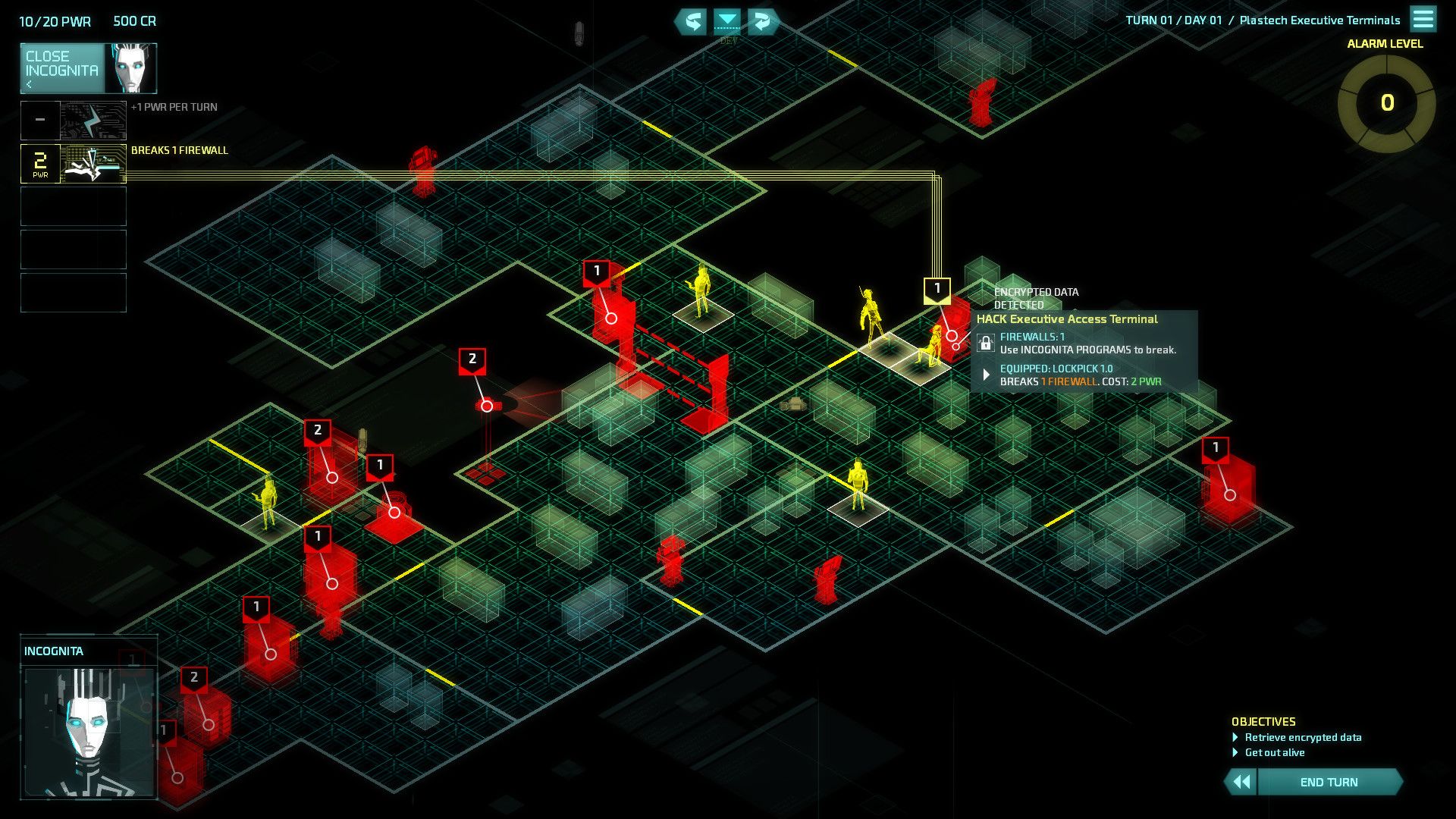
(Image credit: Klei Entertainment) The first contrast is between the familiar and the new. You start with two characters (you can rescue further operatives along the way) whose movements around grid-based locations are governed by AP, or action points. Following basic stealth protocols, you stay in cover, look ahead before you advance, and only engage guards as a last resort. But there's already another crucial resource to consider: power. You won't get far unless you remotely disable security cameras, drones, and laser grids, or access locked workstations and safes. And you can't do that if you don't maintain your power supply by activating replenishment programs or leeching from on-site terminals.
When it comes to the rules and flow of play, Invisible Inc revolves around simultaneous extremes of transparency and opacity, or information that is either remarkably abundant or completely absent. First there's what you don't know. When you start one of the procedurally generated missions, the facility's layout is a mystery. You teleport into an empty square room with one or more doors; beyond that, somewhere there's your main objective, and somewhere there's the exit. Guards could be anywhere, either about to walk in on you or patrolling deeper into the complex. You'll have to figure it all out as you move.
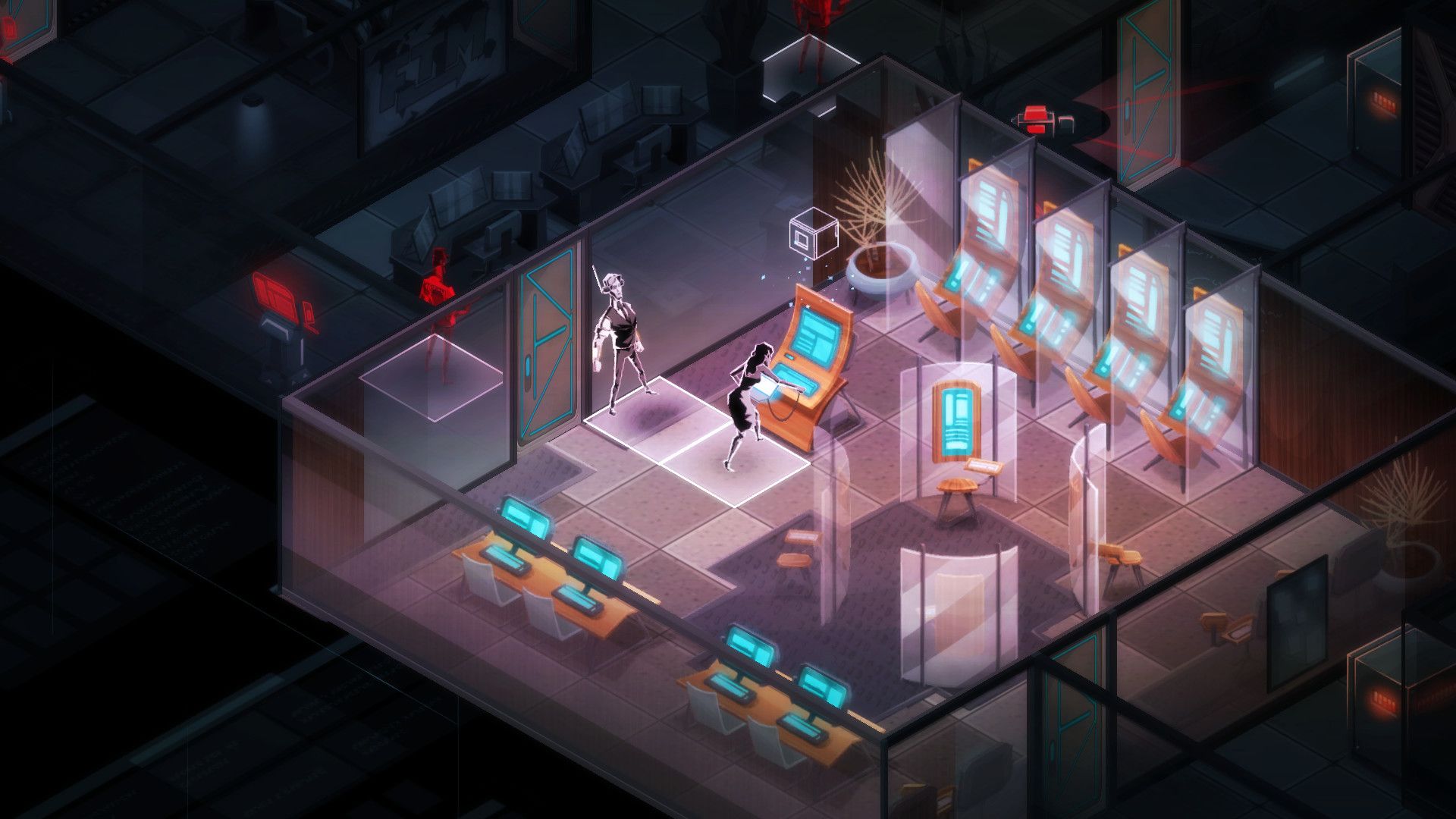
(Image credit: Klei Entertainment) As for what you do know, the rule is that once you can see something, intel on it is instant and comprehensive. This is a carryover from Klei Entertainment's previous game, Mark of the Ninja, where line of sight immediately clarifies the status of objects and enemies. Here, in a turn-based world, the concept goes a step further. If a guard is visible, you can read about any armor or special abilities he has, and perceive his exact cone of vision. Use an action point, and you can even check the path of his next move. With this knowledge, your fragile but resourceful characters can assume control. Walk through a guard's peripheral vision on your way to cover, for example, and his attention will turn to that spot, giving you a window to sneak up and rifle through his pockets or escape unseen.
The simple and predictable nature of the AI is part of the game's drive to eliminate ambiguity. Even combat, when it does occur, is strictly binary. Either you have a weapon that can knock out or kill a particular guard, or you don't, and if you attack, the result is guaranteed. You never have to second-guess what the enemy will do and you never have to think about probabilities. You merely have to choose from the many possibilities laid out in front of you. Surprises only occur when you blunder forward blindly, or fail to consider what you've been told.
The bells are ringing
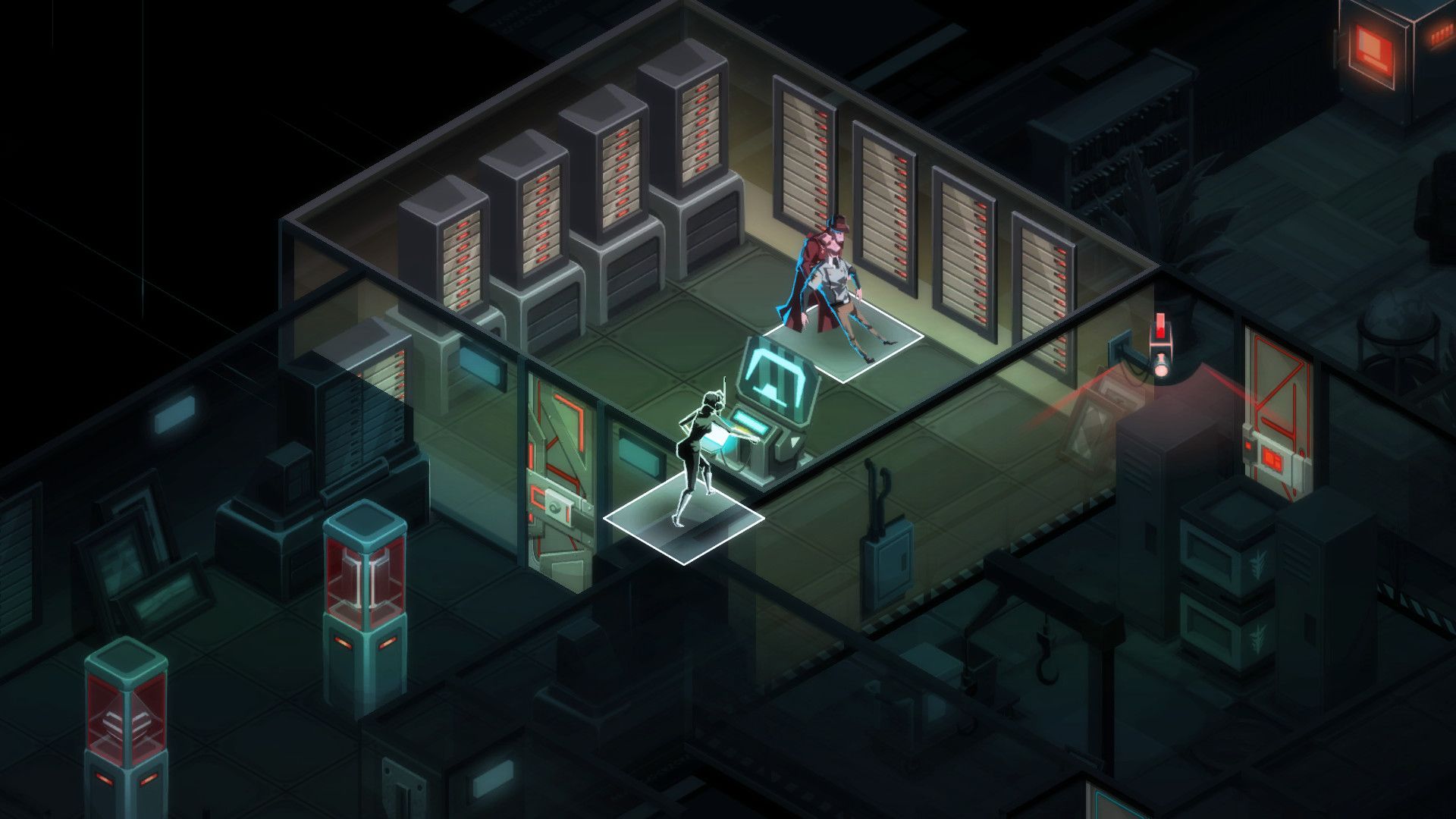
(Image credit: Klei Entertainment) This absolute transparency, coupled with the contemplative nature of turn-based play, suggests cool, methodical advancement. But again that's only the half of it. The other half is urgency, pressure and panic, and it mostly comes from a single cause: the alarm level. The big twist in Invisible Inc is that while you arrive in each facility undetected, the enemy security network becomes more alert to your presence after every turn, and introduces new threats at certain thresholds – extra cameras, increased firewalls, more guards. Also, any time you get spotted, hack a booby-trapped system or use lethal force, the level jumps up even more. The longer you hang around and the more mistakes you make, the harder it is to get anything done.
The most precious commodity thus isn't AP or power, but turns themselves. While you don't have to worry whether or not an action will succeed, you must consider its efficiency. Any decision can have a vital fallout in terms of time that will alter how the mission unfolds. Do you split your team up to cover more ground, or keep them together to gang up on threats? Do you spend valuable turns sneaking around a guard, or knock him out? If you knock him out, do you drag him with you and keep him pinned down, or rush on knowing he'll soon recover and start searching for you? Do you use a large chunk of power to neutralise a camera instantly, or conserve some and do it more gradually? Do you hack a safe or facility map protected by a daemon program that could disrupt your own systems? In each case, your worst enemy might be indecisiveness, but you can't afford to be inflexible either, as conditions are in constant flux.
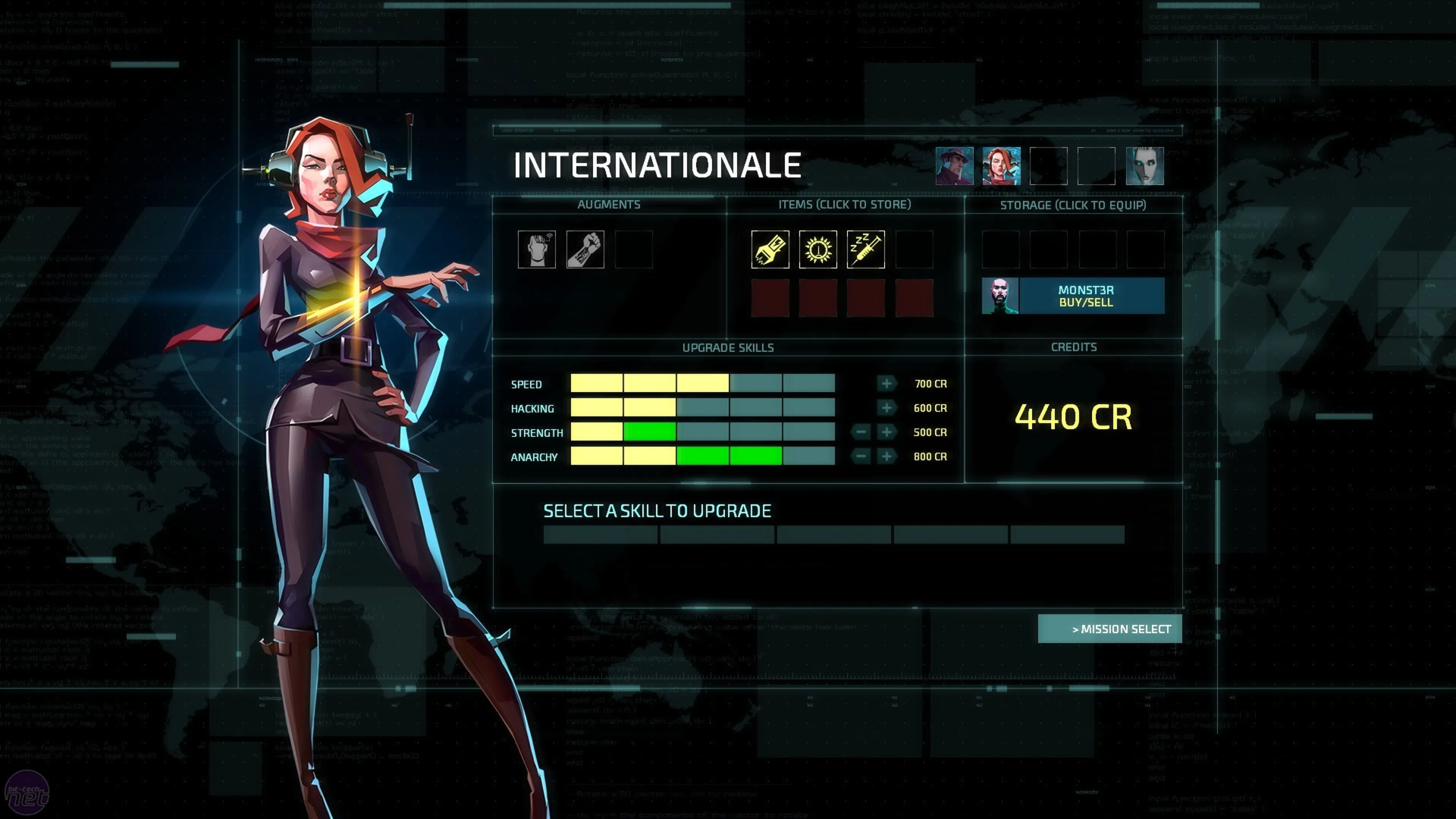
(Image credit: Klei Entertainment) Choosing when to do something often becomes as important as choosing what to do, especially towards the end of a mission. The only essential requirement to keep the game alive is to reach the exit with at least one character, but if you're going to survive long-term and prepare sufficiently for the challenging endgame, it's best to get everyone out, complete your objective, and steal plenty of loot. The temptation, then, is always to look in every room and empty every safe, risking staying longer than necessary to extract maximum gains from each mission. But as firewalls increase and the guards close in, there's a point where it's smarter to cut and run.
Perhaps you have an agent crouched in a dead end, far from the exit, waiting to loot a well-protected safe. You need your power to recharge a little more to hack the lock, yet every turn you stay put the facility bolsters its defences, and your escape route becomes increasingly deadly. Maybe the rest of your squad is already at the exit, caught between hanging around to help the straggler or getting out now. Having come this far, is it worth another couple of turns to open that safe, or will it ruin everything? Few games make doing nothing feel so daring.
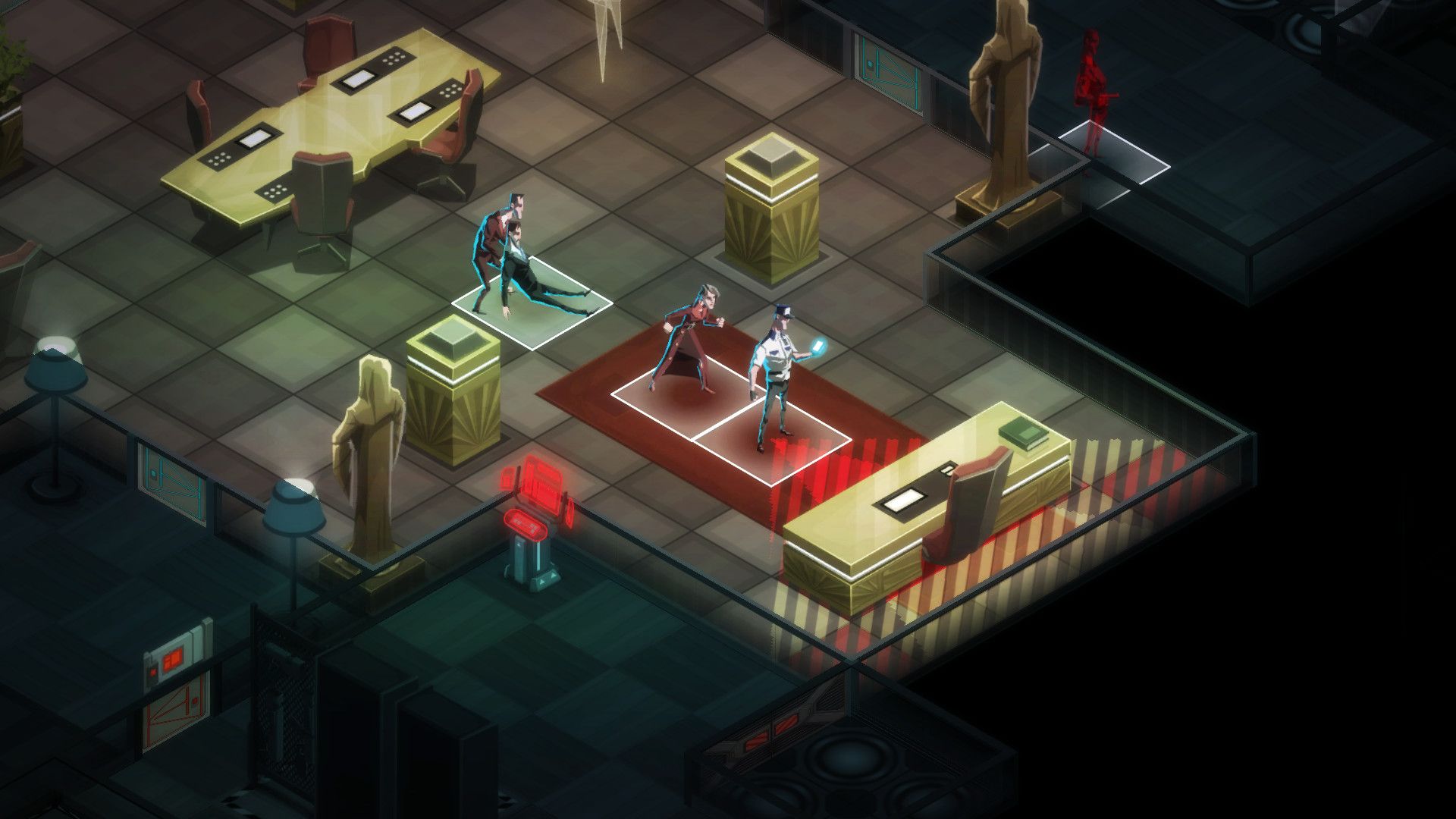
(Image credit: Klei Entertainment) Crucially, the balance in Invisible Inc between stasis and timing, knowledge and ignorance, predictability and risk, is so fine that almost every mission escalates with the suspense of a good heist movie. They all play out differently, due to the random layouts. A large room with a concentration of intersecting patrols is a different proposition to a series of small rooms with stationary guards, for example. Or simple factors such as the position of the exit in relation to the main objective can dramatically change the route you have to navigate. But since you'll try to extract maximum resources regardless, you consistently push to the limit, and invariably end up running for the exit with half-a-dozen enemies homing in on your position.
These hair's-breadth victories reflect the game's final congruent dualism: the combination of Roguelike structure with the feel of a conventional one-and-done adventure. By default it teaches you how to play through its Beginner difficulty, and you could easily finish the six-hour campaign on your first attempt. Klei's gamble is that you'll want to repeat the process again and again, each time ratcheting up the challenge and going deeper into the tactical intricacies. As you do, you'll unlock different starting characters and hacking programs, each of which brings its own unique opportunities and challenges. You won't see anything drastically different in the missions themselves (although a substantial DLC package does change things up), but experimenting with different parameters keeps the experience endlessly fresh.

(Image credit: Klei Entertainment) The game's use of permadeath is also carefully tempered, even when you get to the highly taxing Expert and Expert Plus difficulty levels. Being spotted is a problem, but there's usually a way out. And because you have multiple agents at your disposal, losing one isn't the end of the world. If a character is taken down, you may be able to resuscitate them or drag them to the exit, once the coast clears. Or, if all else fails, there's a limited-use rewind feature that enables you to take whole turns again. Sometimes you lose everyone nonetheless, and it can be hard to take when you're close to the end of a run, but at least permadeath isn't sudden death. You always have time to weigh up your options, experiment with the game's systems, and fashion last-ditch plans.
When you do succeed, perhaps inevitably it's a matter of walking a tightrope between opposites – action and inaction, attack and defence, spending and saving, safety and risk. Every decision is potentially important, and victory is rarely so emphatic that it couldn't have turned to defeat. Somehow this feels like a reflection of the game's design. Invisible Inc never asks anything of you that it hasn't already done itself.
This Invisible Inc article was first published in issue 354 of Edge Magazine. To get more like this delivered straight to your doorstep (or digital device) consider subscribing to Edge.
[/url]

Jat AI
Stay informed with the latest in artificial intelligence. Jat AI News Portal is your go-to source for AI trends, breakthroughs, and industry analysis. Connect with the community of technologists and business professionals shaping the future.