












How Cara pioneers domain-specific AI for enterprise insurance brokerages with AWS
In this post, we explore how Cara, built in cooperation with AWS, addresses these challenges. We walk through the technical design decisions and the AWS services that support the solution. We also share measurable outcomes Cara has delivered for enterprise brokerages.
Insurance is an $8 trillion global industry burdened by manual workflows and a growing talent shortage. Cara delivers an AI-native solution on AWS that automates back-office processes for insurance brokerages.
Insurance agents routinely spend hours on repetitive tasks. These include completing applications, analyzing policy coverages, re-keying data across systems, and relaying information between clients and carriers. As the industry faces a persistent talent shortage, brokerages need to scale revenue without proportional headcount increases.
In this post, we explore how Cara, built in cooperation with AWS, addresses these challenges. We walk through the technical design decisions and the AWS services that support the solution. We also share measurable outcomes Cara has delivered for enterprise brokerages.
The challenge: Why generic AI falls short in insurance
Insurance brokerages operate in a highly regulated environment. Every transaction demands precision, auditability, and compliance. The data involved includes sensitive personally identifiable information (PII), financial records, and underwriting details.
Generic AI tools are not designed for this complexity. Effective AI for insurance must understand domain-specific data models and brokerage workflows. It must also handle carrier-specific requirements and regulatory constraints while meeting enterprise security standards.
Cara’s founding team saw these gaps firsthand. Vic Yeh, Nikhil Kansal, and Jon Patel previously founded a digital insurance brokerage. They scaled and sold it to The McGowan Companies, one of the largest privately held insurance organizations in the US.
During that experience, the team built an internal AI copilot powered by large language models (LLMs). The copilot reduced turnaround times, improved data accuracy, and streamlined agent workflows. Encouraged by strong adoption, they expanded the concept into a standalone product: Cara.
Architecture overview
Cara is built on AWS services chosen for reliability, scalability, and security. Figure 1 shows the high-level components of Cara’s production deployment.
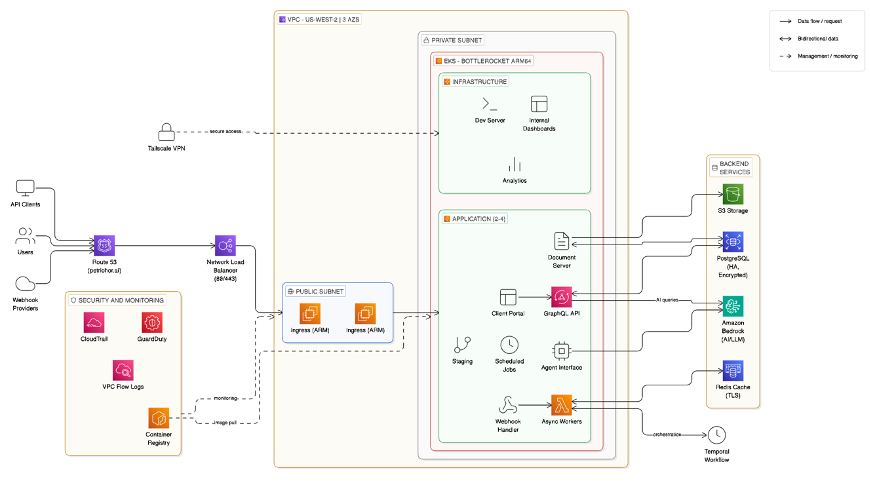
Cara architecture on AWS
Compute and orchestration
Cara runs on Amazon Elastic Kubernetes Service (Amazon EKS) for container orchestration across multiple Availability Zones. EKS manages Cara’s microservices, including ingestion pipelines, workflow engines, and the inference layer.
This architecture supports elastic scaling to handle demand during peak renewal and servicing periods. It supports thousands of concurrent users and workflows per brokerage. Each organization’s workloads run in isolated namespaces for tenant separation.
AI and inference
Cara’s AI capabilities are powered by LLMs hosted on Amazon Bedrock. Amazon Bedrock provides access to foundation models through a fully managed API. This allows Cara to run inference without managing GPU infrastructure. Cara uses Amazon Bedrock for several core capabilities:
- Coverage and quote intelligence – compares carrier quotes, summarizes coverage differences, and highlights exclusions or gaps.
- Application and form automation – cross-fills ACORD and supplemental forms using source documents, prior submissions, and agency guidelines.
- Proposal and renewal generation – produces branded, client-ready proposals and renewal spreadsheets.
- Knowledge-driven workflows – references agency-specific guidelines, carrier appetites, and historical placements to guide decisions.
Security and data isolation
Data protection is a foundational requirement for insurance organizations. Cara’s architecture uses account-specific deployments on AWS. Each brokerage’s data and workflows are isolated within dedicated, secure workspaces. This design supports compliance with industry regulations and provides auditability at the organization level.
Integrations
Cara integrates with leading agency management systems (AMS) and customer relationship management (CRM) tools. It syncs accounts, policies, and documents to reduce duplicate data entry. AI-driven workflows operate directly within existing broker technology stacks. This design helps minimize changes to the systems their agents already use.
Deployment and operational characteristics
One of Cara’s design goals is fast time-to-value. Enterprise brokerages can get onboarded within hours and launch customized workflows within days. Cara’s deployment on EKS uses parameterized templates for each new tenant. It provisions isolated namespaces, storage, and inference endpoints without manual setup.
In production, Cara’s infrastructure on AWS provides:
- High availability – multi-AZ deployment on EKS with automated failover.
- Elastic scaling – Kubernetes Horizontal Pod Autoscaler adjusts capacity based on real-time demand. This supports thousands of concurrent users during peak periods.
- Enterprise security – data isolation per tenant, encryption at rest and in transit, and integration with AWS Identity and Access Management (AWS IAM).
Measurable outcomes
Cara’s AI-driven workflows have delivered quantifiable results for enterprise insurance brokerages:
| Metric | Result |
| Time saved per user | ~10 hours per week through workflow automation and contextual knowledge retrieval |
| Onboarding speed | Enterprise brokerages onboarded within hours; custom workflows live within days |
| Concurrent capacity | Thousands of concurrent users and workflows per brokerage |
| Adoption | Used by hundreds of leading insurance agencies and brokerages |
These outcomes come from organization-specific workflow automation and contextual knowledge retrieval. They depend on Cara’s domain-specific AI and the scalable, secure infrastructure provided by AWS.
Looking ahead
The insurance industry remains in the early stages of AI adoption. As enterprise demand grows, Cara continues to expand its AI-driven workflows across sales, servicing, and operations.
“We are thrilled to advance the boundaries of domain-specific AI in real-world insurance use cases with AWS,” says Vic Yeh, CEO of Cara. “Our goal is to help insurance professionals return to the core of our industry: the relationships.”
Conclusion
In this post, we showed how Cara built a domain-specific AI solution for insurance brokerages using Amazon EKS and Amazon Bedrock. The architecture delivers tenant-isolated, elastically scaling workspaces. It supports thousands of concurrent users while meeting the security and compliance requirements of the insurance industry.
To learn more about building AI-powered applications on AWS, visit the AWS Architecture Center. To get started with Amazon Bedrock, see Getting started with Amazon Bedrock. For Amazon EKS, see Getting started with Amazon EKS.
About the authors