


















This sim racing bundle from PXN proves that direct drive doesn't need to cost a premium, but F1-style wheels are a different story
Anyone who’s followed Formula 1 in the last few years knows that a lot of the most interesting action happens in the midfield. There may not be as much attention or fanfare given to it, but look away from the leader, and there’s fierce battling going on all over the place. Sim racing has a similar situation brewing. Direct drive racing wheels for PC were previously reserved for the championship leaders, but in the last couple of years we’ve seen that technology filter quickly down the field. PXN is one of the more recent names to take a run at that space. Best known for more budget wheels at the cheaper end of the grid, it launched a direct drive range of its own last year, with the VD4, VD6, and VD10 bases covering 4Nm, 6Nm, and 10Nm of torque respectively. The PXN VD6 Bundle in the middle comes in at a reasonable $379/£409 and includes a 6Nm wheelbase, a 280mm round wheel, a two-pedal set, and a desk clamp. That lineup and price tag put the VD6 squarely up against the MOZA R5 and Logitech G RS50, both of which I've spent plenty of time with in the past. I've now been racing with the VD6 Bundle for a couple of weeks to see if PXN's hardware should have the leaders looking in their mirrorsDesign (Image credit: Future / Duncan Robertson) Don’t tell my editor, but the design section of sim racing reviews almost writes itself at this stage. I could probably copy and paste a lot of my MOZA R3 words here and call it a day. The PXN VD6 follows the pack when it comes to design. It’s a pretty plain black cube with some go-faster fins down each side, inputs around the back, and a quick-release on the front. It’s a method that works for everyone else, and it’s equally as successful here. I was also braced for the usual compromises of sim racing gear at this price, though in fairness I don't have any real complaints about the VD6 base itself. It’s weighty and solid, with an aluminium shell that both feels premium and assists with thermal management. The rest of the bundle is a step down. The round wheel that’s included in the box is fine, but it's not in the same class as the wheelbase, and the same goes for the pedals. They both do the job but certainly feel much more like an entry-level pair. That’s where the PXN GT ONE wheel comes in. It’s a standalone 300mm GT-style wheel that’s $219/£219 on its own, or $469/£469 bundled with the VD6 base (if you want pedals, they’re another $89/£89 on top). I’ve been testing it alongside the bundled wheel and found myself not wanting to switch back. This is much more like it. The quality difference is apparent as soon as you open the box. It feels like a proper piece of kit and fully in line with the self-assured quality the wheelbase gives off. The rubber on the grips is comfortable and has a more grown-up vibe than the textured faux leather of the default wheel. There's a good weight and solidity to the rim, and I much prefer the feel of the GT ONE's buttons, all of which are fully backlit.Features (Image credit: Future / Duncan Robertson) The VD6 sits in what I consider to be the direct drive sweet spot, delivering 6Nm of constant torque with peaks of 7Nm and a 24-bit encoder for precision. That's plenty for most amateur sim racers, particularly anyone new or stepping up from a gear or belt-driven wheel like the staple Logitech G923. The included W AS wheel has a modest yet reasonable 12 buttons laid out around the rim, along with a simple D-pad, two rotary encoders, and RPM lights. The shifter and clutch paddles on the back are aluminium and use Hall Effect sensors, which was a pleasant surprise. The GT ONE is in a different league entirely. There are still 12 buttons, though here they’re larger, backlit, and laid out in a more authentic way than on the W AS, which leans more like an arcade controller than a simulation tool. PXN includes a sticker sheet in the box, too, so you can customize each button with a clear label. These sit alongside three rotary encoders on the main face, two thumb encoders, and two directional sticks, with magnetic shift paddles, Hall effect clutch paddles, and a row of RPM LEDs along the top. The brass-colored thumb encoders are great, though it's a shame they only twist and don't push too for a bonus input. (Image credit: Future / Duncan Robertson) I’m less fond of the three rotary encoders on the front. They're too light for my liking, and I found them easy to overshoot the setting you wanted, particularly if only looking to turn them a single step. The PD HM pedals are a pretty simple two-pedal set, though you can add a separate clutch pedal at a later date if you so wish. Both pedals use Hall effect sensors, meaning no load cell braking, and the resistance feels relatively light on both. They connect to the wheelbase via an onboard USB hub on the back, which also has a couple of spare ports for additional accessories like a shifter or button box. Like so much sim racing gear, the PXN VD6 Bundle is PC only with no console support whatsoever
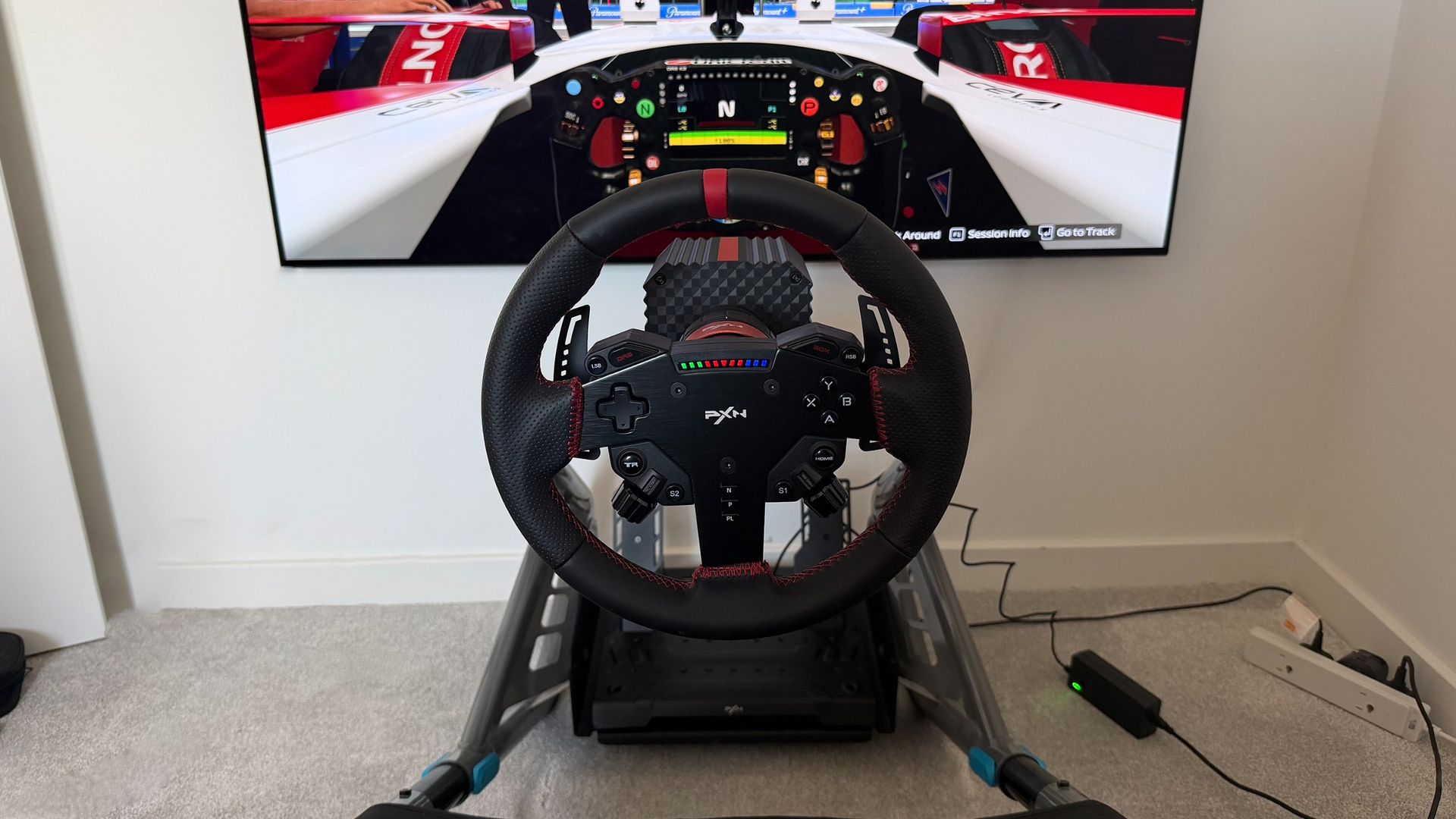 Anyone who’s followed Formula 1 in the last few years knows that a lot of the most interesting action happens in the midfield. There may not be as much attention or fanfare given to it, but look away from the leader, and there’s fierce battling going on all over the place. Sim racing has a similar situation brewing. Direct drive racing wheels for PC were previously reserved for the championship leaders, but in the last couple of years we’ve seen that technology filter quickly down the field.
PXN is one of the more recent names to take a run at that space. Best known for more budget wheels at the cheaper end of the grid, it launched a direct drive range of its own last year, with the VD4, VD6, and VD10 bases covering 4Nm, 6Nm, and 10Nm of torque respectively. The PXN VD6 Bundle in the middle comes in at a reasonable $379/£409 and includes a 6Nm wheelbase, a 280mm round wheel, a two-pedal set, and a desk clamp.
That lineup and price tag put the VD6 squarely up against the MOZA R5 and Logitech G RS50, both of which I've spent plenty of time with in the past. I've now been racing with the VD6 Bundle for a couple of weeks to see if PXN's hardware should have the leaders looking in their mirrors
Design
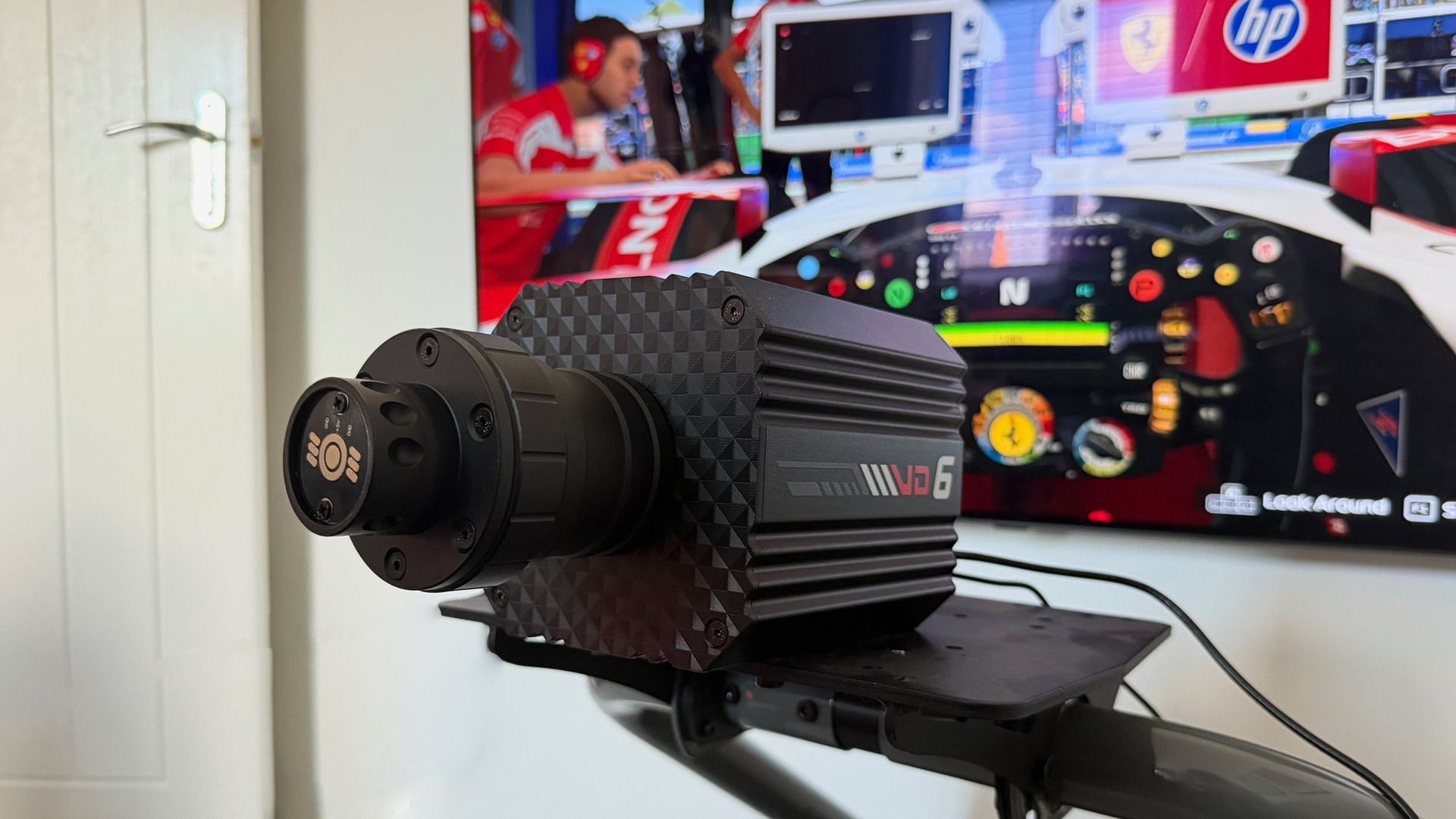
(Image credit: Future / Duncan Robertson) Don’t tell my editor, but the design section of sim racing reviews almost writes itself at this stage. I could probably copy and paste a lot of my MOZA R3 words here and call it a day. The PXN VD6 follows the pack when it comes to design. It’s a pretty plain black cube with some go-faster fins down each side, inputs around the back, and a quick-release on the front. It’s a method that works for everyone else, and it’s equally as successful here.
I was also braced for the usual compromises of sim racing gear at this price, though in fairness I don't have any real complaints about the VD6 base itself. It’s weighty and solid, with an aluminium shell that both feels premium and assists with thermal management. The rest of the bundle is a step down. The round wheel that’s included in the box is fine, but it's not in the same class as the wheelbase, and the same goes for the pedals. They both do the job but certainly feel much more like an entry-level pair.
That’s where the PXN GT ONE wheel comes in. It’s a standalone 300mm GT-style wheel that’s $219/£219 on its own, or $469/£469 bundled with the VD6 base (if you want pedals, they’re another $89/£89 on top). I’ve been testing it alongside the bundled wheel and found myself not wanting to switch back. This is much more like it. The quality difference is apparent as soon as you open the box. It feels like a proper piece of kit and fully in line with the self-assured quality the wheelbase gives off. The rubber on the grips is comfortable and has a more grown-up vibe than the textured faux leather of the default wheel. There's a good weight and solidity to the rim, and I much prefer the feel of the GT ONE's buttons, all of which are fully backlit.
Features
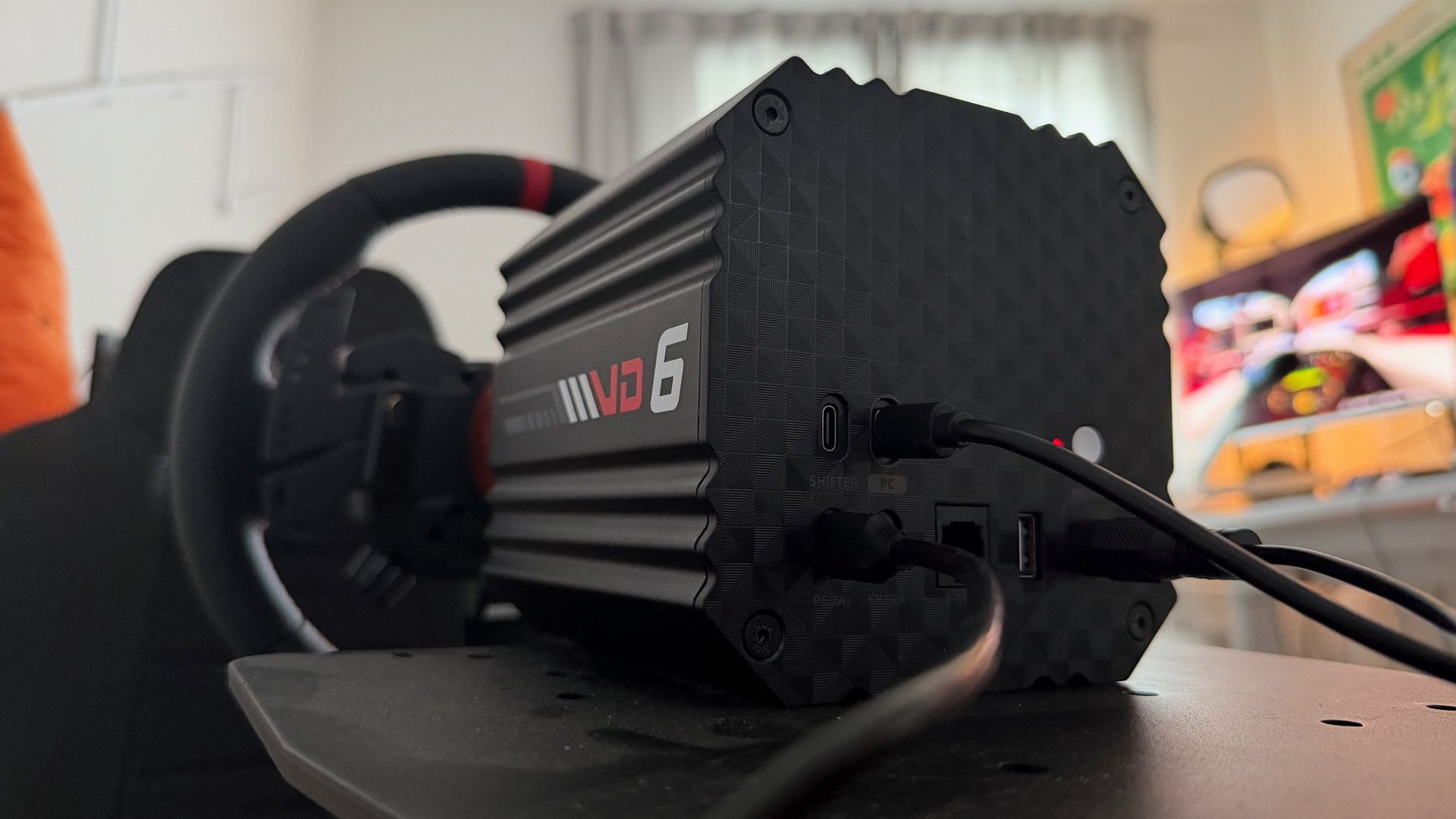
(Image credit: Future / Duncan Robertson) The VD6 sits in what I consider to be the direct drive sweet spot, delivering 6Nm of constant torque with peaks of 7Nm and a 24-bit encoder for precision. That's plenty for most amateur sim racers, particularly anyone new or stepping up from a gear or belt-driven wheel like the staple Logitech G923. The included W AS wheel has a modest yet reasonable 12 buttons laid out around the rim, along with a simple D-pad, two rotary encoders, and RPM lights. The shifter and clutch paddles on the back are aluminium and use Hall Effect sensors, which was a pleasant surprise.
The GT ONE is in a different league entirely. There are still 12 buttons, though here they’re larger, backlit, and laid out in a more authentic way than on the W AS, which leans more like an arcade controller than a simulation tool. PXN includes a sticker sheet in the box, too, so you can customize each button with a clear label. These sit alongside three rotary encoders on the main face, two thumb encoders, and two directional sticks, with magnetic shift paddles, Hall effect clutch paddles, and a row of RPM LEDs along the top. The brass-colored thumb encoders are great, though it's a shame they only twist and don't push too for a bonus input.
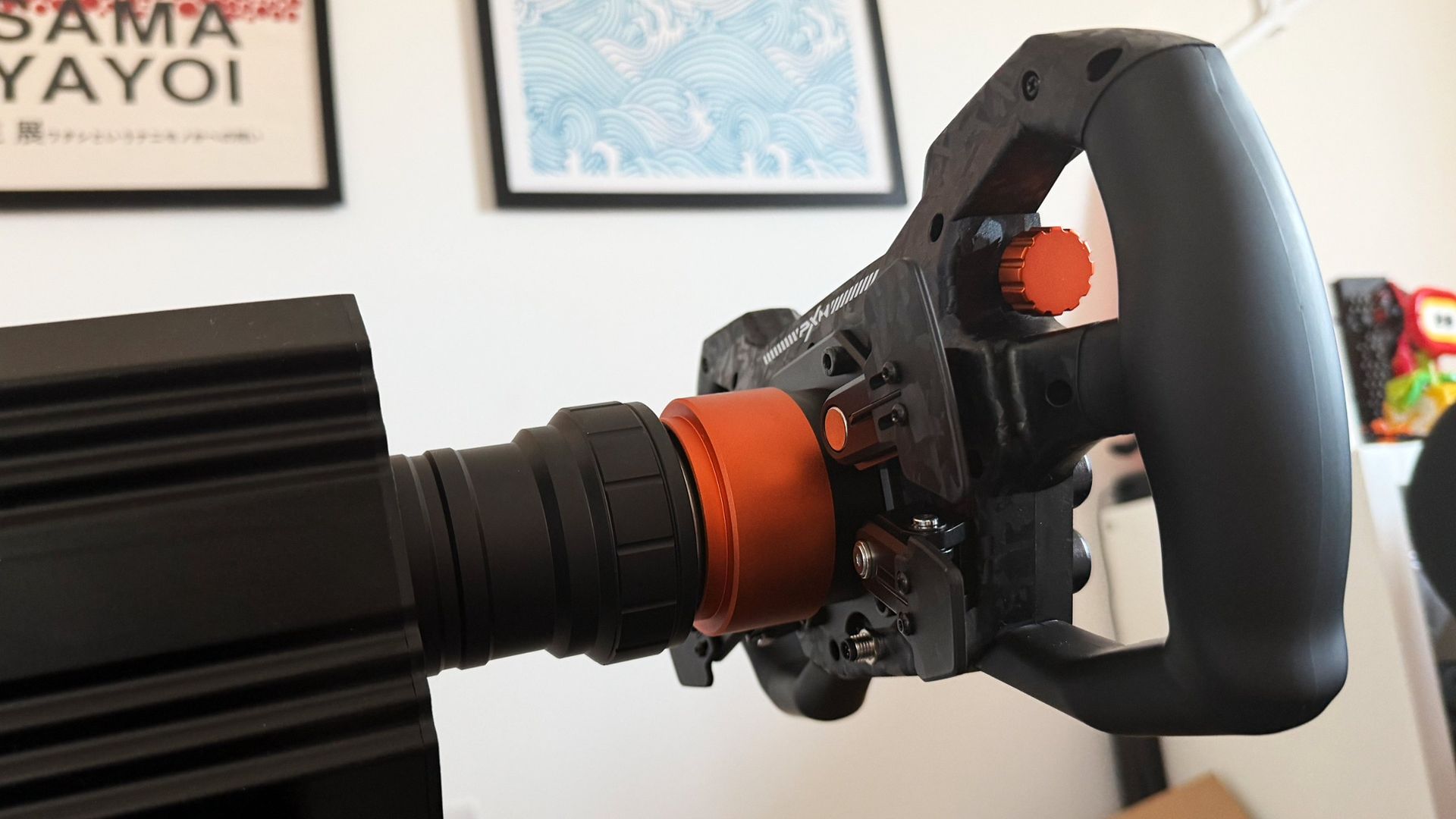
(Image credit: Future / Duncan Robertson) I’m less fond of the three rotary encoders on the front. They're too light for my liking, and I found them easy to overshoot the setting you wanted, particularly if only looking to turn them a single step.
The PD HM pedals are a pretty simple two-pedal set, though you can add a separate clutch pedal at a later date if you so wish. Both pedals use Hall effect sensors, meaning no load cell braking, and the resistance feels relatively light on both. They connect to the wheelbase via an onboard USB hub on the back, which also has a couple of spare ports for additional accessories like a shifter or button box. Like so much sim racing gear, the PXN VD6 Bundle is PC only with no console support whatsoever.
Performance
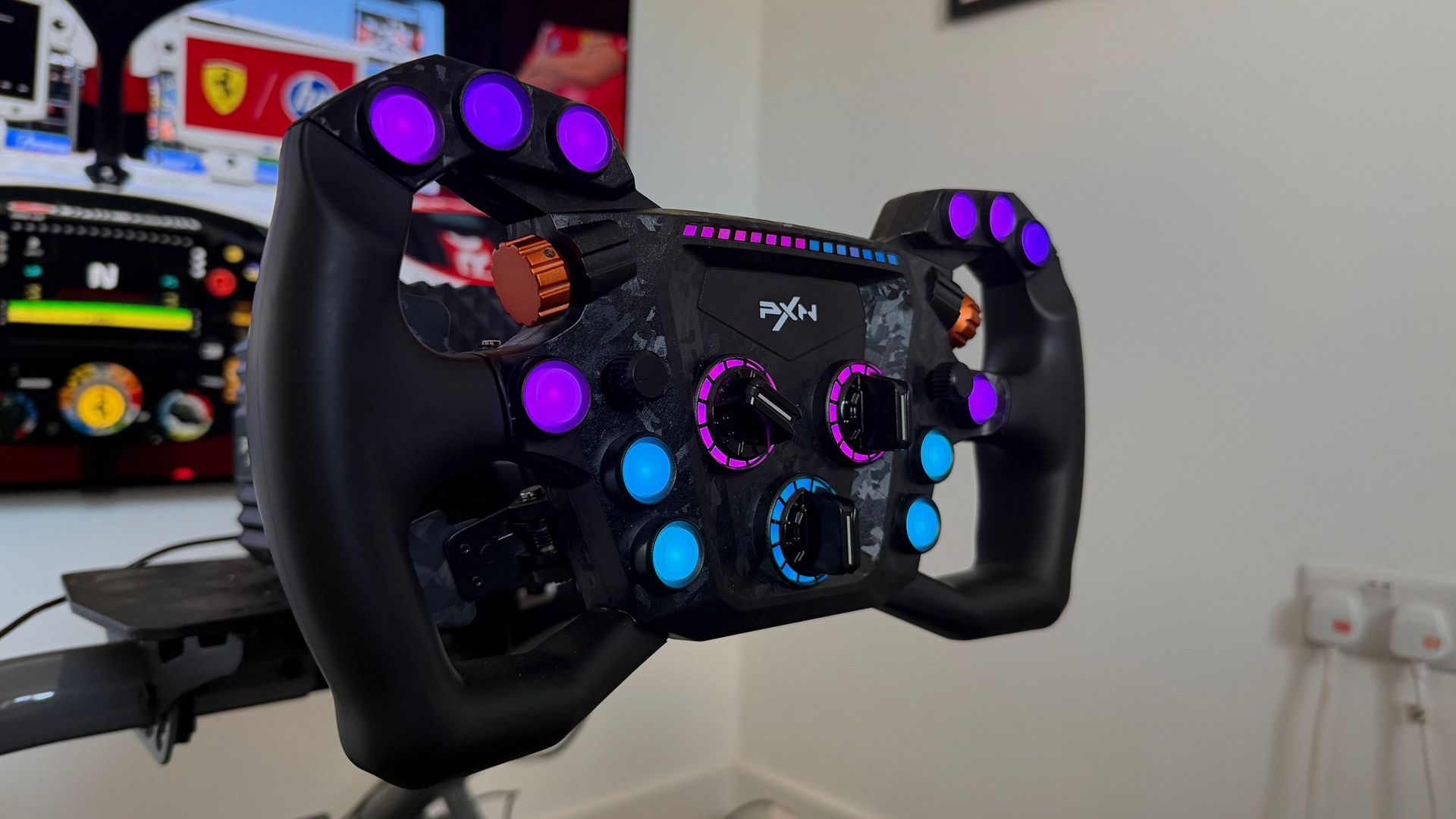
(Image credit: Future / Duncan Robertson) Rather than use the included desk mount, I bolted the VD6 to my Playseat Trophy Logitech G Edition, which has taken a bunch of other direct drive wheelbases without complaint. Here, however, I couldn't find a set of holes in the mounting plate that simultaneously lined up with the four bolt holes on the bottom of the PXN. I could only get a couple in any position I tried, and while this did hold firm enough, it isn't ideal. The pedals were the same, and arguably worse. There was always a little bit of play, particularly in heavy braking zones. Oh, and one tip: make sure to plug in all of your pedal cables before you mount them to a rig. Doing it afterwards without unbolting everything is incredibly fiddly, and no, I won't be taking questions on how I know that.
Getting racing also took far longer than it should have and is an area where it becomes apparent you’ve strayed away from a market-leading brand. Updating firmware across all parts of the bundle turned into a solid hour of faff, with the pedals going from recognized to not recognized and the GT ONE refusing to show up at all until the wheelbase was updated. Update one thing, and the app would tell me another component had rolled back. I had to roll back and start over multiple times before it finally seemed to stick. Things are fine now, mercifully, and the most recent wheelbase update went through smoothly, so fingers crossed PXN has got things in order.
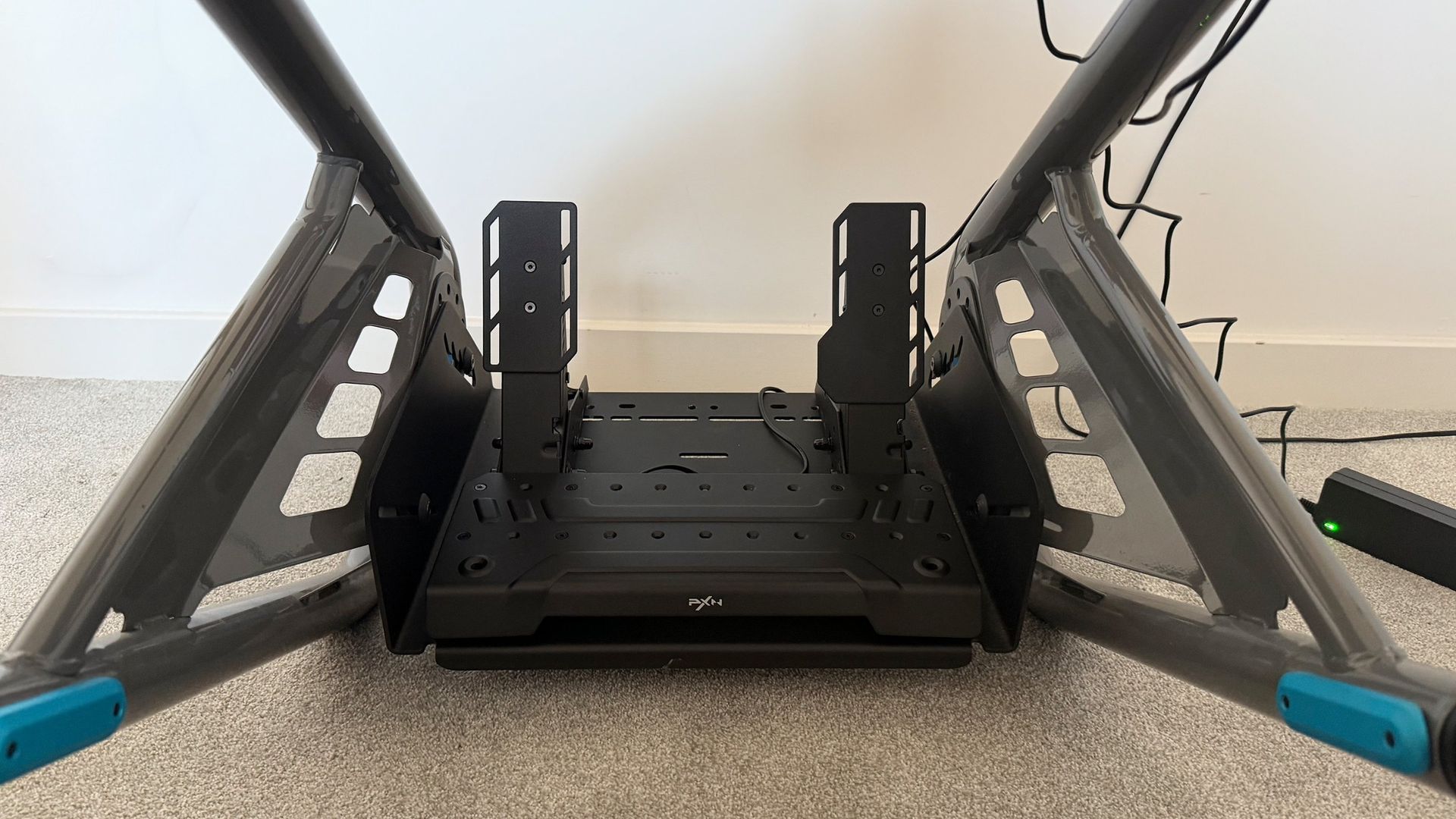
(Image credit: Future / Duncan Robertson) I spent most of my time in the EA SPORTS F1 25: 2026 Season Pack, Forza Horizon 6, and EA WRC, all of which are listed as compatible in PXN’s documentation. Sadly, as is so often the case, every one needed manual configuration and button mapping, even when I'd used the PXN app to supposedly set things up first. It's irritating. The brighter news is that with buttons mapped, everything worked reliably and force feedback came through in every game. I did need to spend a while tinkering in Forza Horizon 6 to dial in the driving experience, and it was a case of trial and error. This isn’t an isolated PXN issue; I’ve found it tricky to get the balance right on other wheels in the past, but don’t expect to immediately hit the streets of Tokyo.
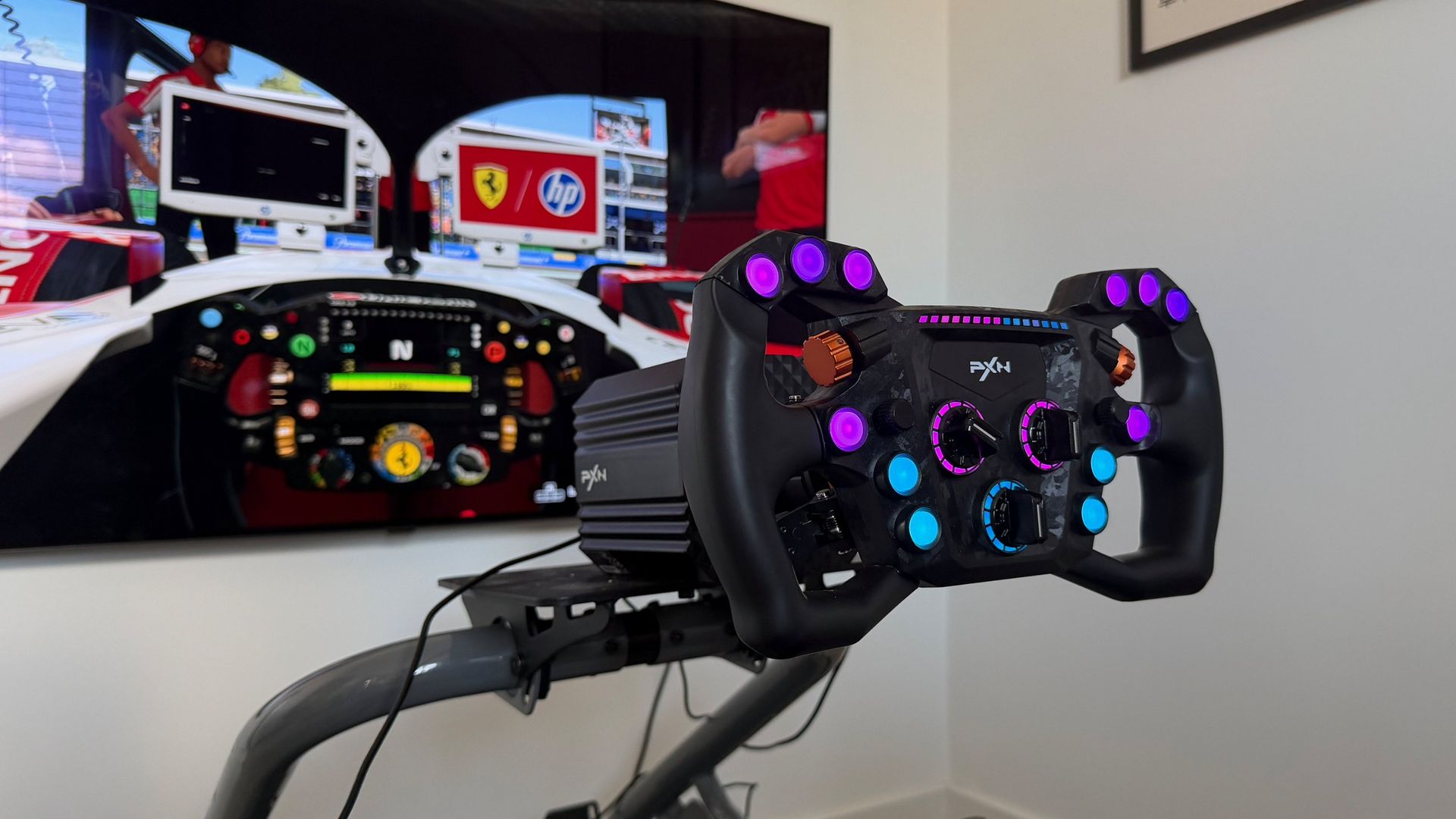
(Image credit: Future / Duncan Robertson) On track, 6Nm never felt short at my level and offered plenty of resistance to lean on around long corners. Truth be told, I only ever crank a stronger wheel like the Logitech G Pro up to maximum oomph for a laugh when someone new sits down, and I fancy freaking them out. You won’t need more than 6Nm for casual day-to-day racing. The force feedback is respectable and gets better the rougher the surface is. Riding a kerb or dipping a wheel into the gravel is always obvious, and there's enough detail to know what the car is doing. On the smooth parts, where you're meant to be in F1 25: 2026 Season Pack, there's less going on, though there's some sensation on standard tarmac, which is more than I got from the Turtle Beach KD3. It isn't best in class. The Logitech RS50 and G Pro are still the best I've used thanks to TRUEFORCE, but there's enough difference between surfaces to leave me feeling dialed in and immersed.
Should you buy the PXN VD6?
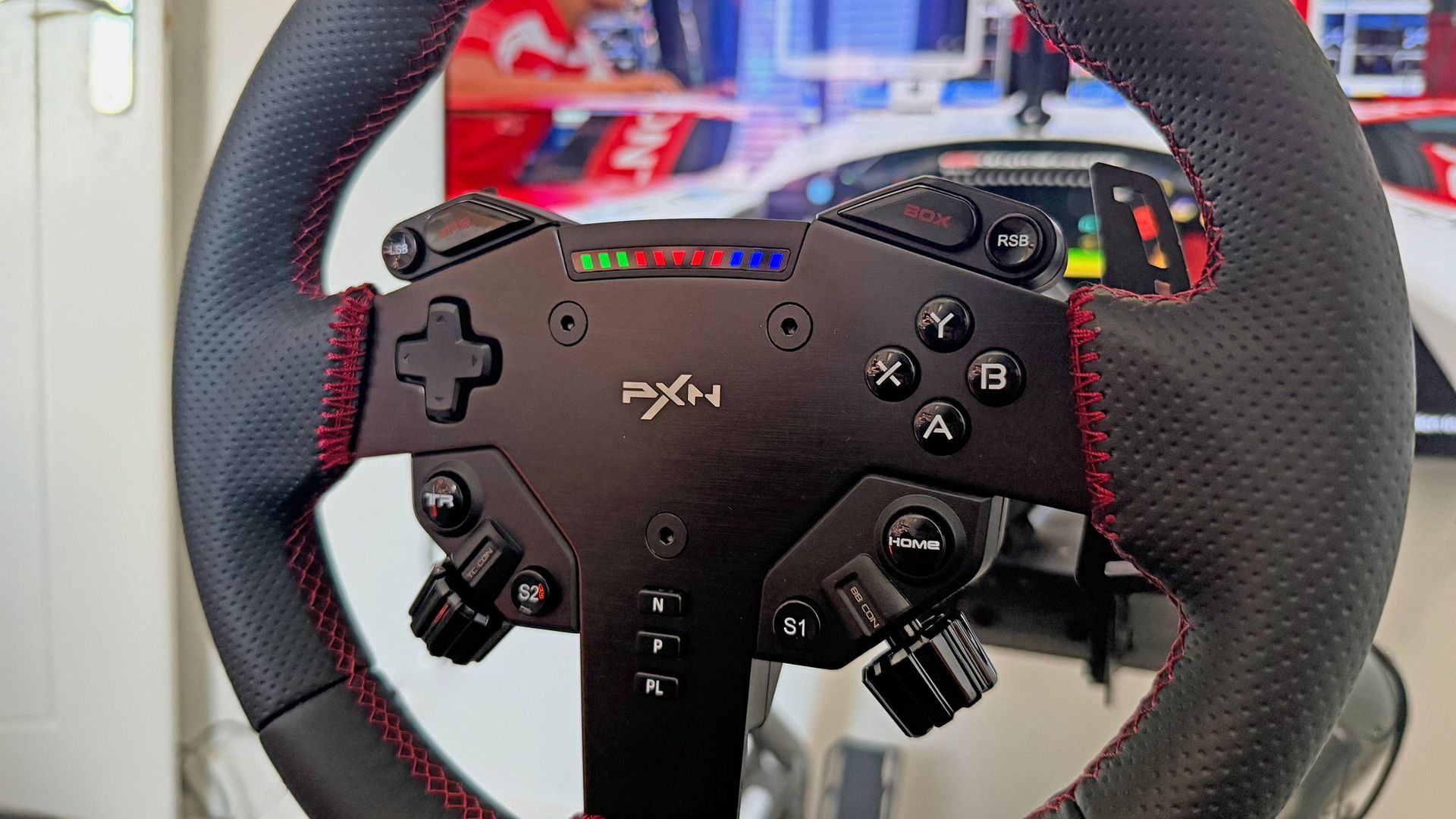
(Image credit: Future / Duncan Robertson) For what it delivers, it has to be said that the VD6 Bundle is good value. At $379/£409 for the full wheel, wheelbase, and pedal set, it's going wheel to wheel with the MOZA R5 and comfortably undercuts the likes of the Nacon Revosim RS Pure. I’d say the wheelbase is better than that price suggests, though the wheel and pedals don't quite reach that same level.
The GT ONE is a clear upgrade and one I highly recommend for track racers, though it skews the value proposition pretty dramatically. The VD6 and GT ONE bundle is $469/£469 without pedals, and the PD HM pedals add another $89/£89, so a full setup comes to somewhere near $560/£560. In the UK, that puts it level with a Logitech RS50 bundle including the track wheel and pedals, which is £550 in Logitech's configurator. The US doesn’t see as good a deal; the same set comes to $750 there. The GT ONE is a nicer wheel than the one in that bundle, but the RS50 has a load cell brake, a smoother app experience and game compatibility, and the best force feedback I've tested with TRUEFORCE.
If you're a PC racer after a direct drive bundle on a budget, and you're prepared to spend time on firmware and button mapping, the VD6 Bundle is easy to recommend. The overall experience is ultimately good; you’ll just have to take the scenic route to get there.
How we tested the PXN VD6 + GT One racing wheel
I tested the PXN VD6 Bundle and PXN GT ONE wheel on PC, mounted to a Playseat Trophy Logitech G Edition. I used both the included wheel and the GT ONE, alongside the PD HM pedals, across EA SPORTS F1 25: 2026 Season Pack, Forza Horizon 6, and EA WRC. Everything was set up and configured through the PXN SimRacing app, updating the firmware as prompted and required.For more on how we test controllers, check out the full GamesRadar+ Hardware Policy.
We review conventional gamepads too - take a look at the best PC controllers, the best TMR controllers, and the best Xbox Series X controllers.
[/url]

Jat AI
Stay informed with the latest in artificial intelligence. Jat AI News Portal is your go-to source for AI trends, breakthroughs, and industry analysis. Connect with the community of technologists and business professionals shaping the future.