













AI data centers could consume more water than Americans drink in a year by 2030, says CEO working on solution
Ecolab CEO Christophe Beck says AI data centers could drink as much water as Americans by 2030 unless direct chip cooling and water recycling catch on.
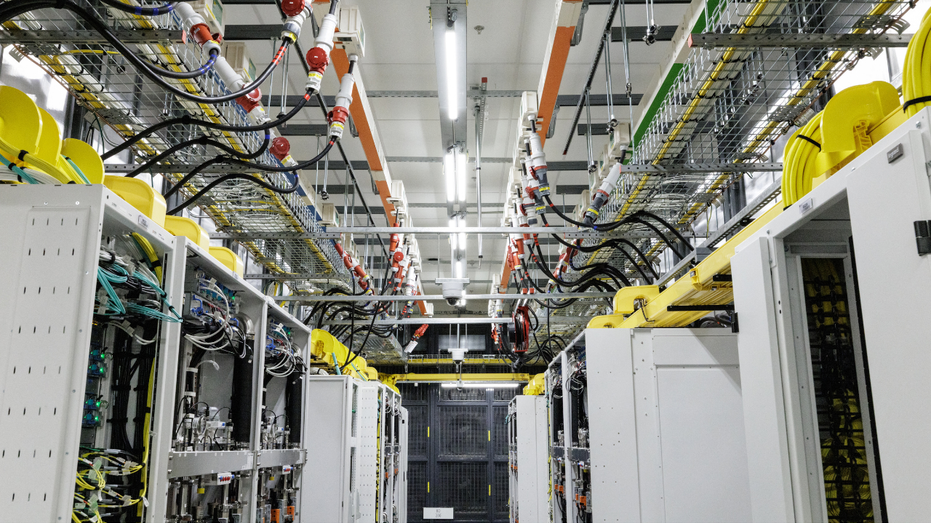
Ecolab CEO Christophe Beck, whose company is working on sustainable solutions to ecological problems like AI data centers’ robust water consumption, said that without reform, AI data centers could wind up consuming more water than Americans drink every year.
"Ninety-five percent of the data centers today use a lot of water," he told Fox News Digital in an exclusive interview. "We estimate that by 2030, with the old technologies in the U.S., we will use as much water to cool data centers as Americans are using for drinking needs."
DAVID MARCUS: WHAT BIG TECH’S WEEKEND FROM HELL MEANS FOR THE FUTURE OF DATA CENTERS
Beck argued that this phenomenon is "not sustainable," and laid out the technologies his company is working on in an effort to reduce data centers’ water consumption.
"Behind AI there's water in every step of the process. You need water to produce the chips, to power the chips and to cool the chips. And for the last four or five years, the chips generation that we were using were just cooled with air," he told Fox News Digital.
However, with the increasing complexity of chips to match an ever-building demand for computer power, air conditioning alone is no longer sufficient to cool chips in data centers, Beck explained.
"You need something that's way stronger. Water is 30 times better at extracting heat than air from the chips. So that's why many of those new data centers are moving toward direct chip water cooling, which ultimately is bringing cold water on top of the chip," he said.
Direct water cooling, he explained, has the dual benefits of increasing efficiency and sustainability, because the water used to cool the chips can be recycled and used on every chip in a given data center.
"So you end up in a place where you have a data center that is much more powerful [than] using no water, using less power, and ultimately not having an impact on natural resources and in communities around us, which is one of the unlocks that people are pushing back so much against right now," he said.
ONE INDUSTRY FACES MULTI-TRILLION-DOLLAR RECKONING AFTER HISTORIC MIDTERM ELECTION RESHUFFLE
On Nov. 4, voters across the U.S. elected lawmakers and executives who ran on campaigns to limit the number of data centers.
In Texas, Democratic Gov.-elect Gina Hinojosa upset incumbent Republican Greg Abbott. Voters who ticked the box for Hinojosa did so after she campaigned heavily on instituting a data center moratorium, a fact that Beck took note of.
THE POWERFUL WAY AMERICAN COMMUNITIES CAN BENEFIT FROM THE NEW TECH BOOM REVEALED BY DATA CENTER CEO
"Most of the data centers that were installed in Texas or anywhere else in the country or in the world, for that matter, were using a lot of water, a lot of power. And that's created a lot of backlash from the communities, which is rightfully so," Beck told Fox News Digital.
Beck noted that while Texas is one of the most economically strong states in the union, it is also one of the most water-stressed.
"It's a bad combination," he said. "Obviously, high growth, great news; no water, less good news. So we've looked at those technological solutions on how do you bring higher growth, more data processing while using much less water."
Beck added that the technologies Ecolab is developing will exclusively be used in new-build data centers, while the political pushback is surrounding the existing, more resource-demanding projects.
Direct cooling allows for what is known as a closed loop system, a method that is far more sustainable and requires less water than previous iterations of water-cooling methods.
Ecolab, Beck explained, has found a way to recycle water not only in the chip cooling process, but in chip fabrication as well, a process that necessitates extremely pure water.
"The so-called fabs, they use huge amounts of water, which is very specialized water because it needs to be ultra pure," Beck explained.
"And that, to be recycled, is even way harder than in a data center. But even there, at Ecolab we found solutions to not only get the highest purity of water to get the most advanced chips, but we can reuse that water as well in ways that are water neutral," he said.
Beck also put in context just how pure the water for chip fabrication needs to be.
"The purity is a million times more pure than what you would inject in your blood if it's a drug. So super high quality, super high purity of water at the end," he said.
"So the way we do it, in short, is ultimately at every step of the process we try to extract the water from that process step. We treat, we purify that water, we bring it back to an ultra-pure water level, and we bring back to the process. And the very special thing that we have at Ecolab, within that water you have some trace materials that we call connected water," he said.
"So we understand the quality of the water throughout the process within the fab or the data center, for that matter, that we know exactly the quality of that water to make sure that the chips are perfectly produced. And we know what we need to do in order to re-treat that water so that it can be reused afterwards. And you end up with better chips, lower cost, and most importantly, water neutral," Beck said.