











Bond with Treasures: The ding, long adrift, preserves history and embodies inheritance
Nanjing, Jiangsu, China, March 24, 2026 -- Did you know The post Bond with Treasures: The ding, long adrift, preserves history and embodies inheritance appeared first on Business Intelligence.

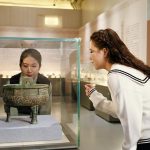
— Did you know? Hidden inside the Museum of Nanjing University is a priceless national treasure. Recently, Taiwan youth Zhang Youjia, student from Nanjing University, together with volunteer He Yushan, visited the museum to explore the stories behind the ding.
Video:https://youtu.be/ufnITmq3uhs?si=ILfliJRfUjC3QUDm
Since enrolling, Youjia has been deeply intrigued by the ding, inspired by the university anthem lyric, “Honesty is a great virtue that moves the world. Like the three legs of the ding that uphold it…” “The ‘three-legged ding’ in our school song refers to vessels like this,” Yushan explained, pointing to the Xiao Ke ding in the display case.
The Xiao Ke ding, now housed in the Museum of Nanjing University, was unearthed in 1890 in the royal heartland of the Zhou dynasty in Shaanxi. It was once part of the collection of Zaixun, younger brother of the Guangxu Emperor and Minister of the Navy in the late Qing dynasty. In 1934, it was donated to the University of Nanking (one of the predecessors of Nanjing University) by its founder, John Calvin Ferguson, and today it is regarded as one of Nanjing University’s most treasured artifacts.
The Xiao Ke ding stands 28.5 cm high with a mouth diameter of 29 cm. Circular in form, it features upright loop handles, a squared, broad rim, a slightly constricted mouth, a deep, drooping belly, and hoof-shaped legs. The outer sides of the handles are decorated with Kui dragon motifs. Beneath the rim, curved, hooked patterns encircle the vessel, divided by six vertical flanges. The belly is adorned with flowing wave-like designs, while the upper parts of the legs bear raised animal-mask motifs. The vessel exemplifies exquisite ornamentation and superb craftsmanship.
Apart from its ornamentation and shape, the greatest value of the Xiao Ke ding lies in its 72‑character inscription arranged in eight lines on the inner wall. The inscription records that in the ninth month of the 23rd year of his reign, King Xiao of Zhou was in Zongzhou and appointed a court cuisine official called Ke to reorganize the Eight Divisions of Chengzhou.
Notably, the Xiao Ke ding and the Da Ke ding, the treasure of the Shanghai Museum, were originally part of a single set. The complete set comprised one large ding and seven smaller ones, but today the eight vessels are scattered across the world.
The exquisite form of the Xiao Ke ding also brought to Youjia’s mind the “star exhibit” Mao Gong ding of the Taipei Palace Museum: “Mao Gong ding had a tough destiny. It changed hands several times after its discovery and was almost seized by the Japanese military. In 1948, it was transported from Xiaguan Wharf in Nanjing to Taiwan.”
“Indeed, Mao Gong ding, Da Ke ding and Da Yu ding are collectively known as the ‘Three Treasures of China’, and the latter two also had quite a turbulent history,” said Yushan. Both Da Ke ding and Da Yu ding were once collected by the renowned late-Qing collector Pan Zuyin. At the time, members of the Pan family risked their lives to protect them, and later his grandson’s wife, Pan Dayu, donated them to the nation.
Youjia remarked that ding still lives on in today’s language and culture, such as idioms like Ding Ding Da Ming (a great reputation) and Yi Yan Jiu Ding (a word which carries weight). Yushan added that Yu the Great cast the nine ding to symbolize the nine regions of ancient China; gathered together, they stood for national unity and prosperity. “The ‘Three Treasures of China’ preserved on both sides of the Taiwan Strait are part of the Chinese nation’s common cultural gems.”
Since September 2025, Modern Express has launched the “Bond with Treasures: Cross-Strait Youth Explore National Treasures” Program. This visit to the Museum of Nanjing University is one of its featured activities. Using the ding as a shared medium, young participants from both sides of the Taiwan Strait come together to reconnect with the enduring legacy of Chinese civilization and to reflect on the common cultural roots that unite them.
Millennia-old ding carries on Chinese culture. Culture is the lifeblood of a nation, and the long-standing Chinese culture is the shared origin and bond of people on both sides of the Strait. As young people from across the Strait walk hand in hand and move forward together, their telling of national treasure stories deepens their sense of identity with the Chinese nation.
Contact Info:
Name: Long Qiuli
Email: Send Email
Organization: Modern Express
Website: https://xdkb.net/
Release ID: 89186729
In case of identifying any errors, concerns, or inconsistencies within the content shared in this press release that necessitate action or if you require assistance with a press release takedown, we strongly urge you to notify us promptly by contacting [email protected] (it is important to note that this email is the authorized channel for such matters, sending multiple emails to multiple addresses does not necessarily help expedite your request). Our expert team is committed to addressing your concerns within 8 hours by taking necessary actions diligently to rectify any identified issues or supporting you with the removal process. Delivering accurate and reliable information remains our top priority.
The post Bond with Treasures: The ding, long adrift, preserves history and embodies inheritance appeared first on Business Intelligence.